Saturday, May 5, 2018

Concerning the Moment

A five paragraph essay by Bartolome Bybee
Edited by W Schantz
a local substitute teacher

From its title, Kierkegaard's Johannes Climacus' Philosophical Fragments, or a Fragment of Philosophy suggests the tautologies and repetitions with variation which follow. In the course of the argument, for example, an imaginary reader will repeatedly address the speaker, frequently at the end of sections, frequently in a tone which seems quarrelsome or at least miffed by what he or she takes to be the philosophical rewriting of a well-known biblical story, rather than an original contribution to the edifice of philosophy. The speaker, for his part, seems to acquiesce and welcome these repeated interruptions. Far from claiming originality, Climacus recurs time and again to an important distinction he claims to be already latent in the philosophical-theological heritage, which he only aims to highlight: the distinction between Socratic recollection, prompted by human beings whose souls are informed by truth from all eternity, and the alternative situation in which truth comes to human beings, themselves in untruth, from the god. The latter's incursion into history Climacus terms "the moment". Paradoxically, Climacus recurs time and again to the moment, reinforcing the importance of its paradoxical nature. Clarification comes early and often in the crucial second section of "Thought-Project," asserting that the paradoxical moment plays out in "The Preceding State," in "The Teacher," and in "The Follower" alike. In each case, Climacus concedes that we can dispense with the paradox, perhaps, but not by imagining we are doing anything original, instead only by returning to the Socratic paradigm.

From the initial statement of Socrates' engagement with interlocutors such as Meno, comprising part A. of "Thought-Project," there is an important shift under heading B.: "If the situation is to be different, then the moment in time must have such decisive significance that for no moment will I be able to forget it, neither in time nor in eternity, because the eternal, previously nonexistent, came into existence in that moment" (13). Climacus poetically incorporates the image of the soul traversing eternity, beholding its truth, and denies he could ever forget such an experience, such is its importance, its meaning for him. Thus he has recourse to imagining another possibility: instead of the soul exploring the eternal, could the eternal come into being to sojourn in human existence? Then, in the following paragraph, which opens the account of "The Preceding State," the language of this key presupposition is invoked once more: "Now if the moment is to acquire decisive significance, then the seeker up until that moment must not have possessed the truth, not even in the form of ignorance, for in that case the moment becomes merely the moment of occasion; indeed, he must not even be a seeker" (13). By discarding the category of a forgotten truth of which one is ignorant, of which one can be reminded and go on recollecting in the future, Climacus arrives at the paradoxical conclusion that, as Meno claims, seeking the truth is impossible. Unless we appeal to Socrates' answer, endowing ourselves with eternal knowledge of which we are temporarily unaware, the only possibility that remains is for us is not to seek truth, but to receive it a free gift.
         
When the language of the moment's decisive significance next surfaces, in the section on "The Teacher," more of its paradoxical nature comes more nearly into the open. First, some allowance is made for Socratic teaching, but only for the discovery of one's untruth: "To this act of consciousness, the Socratic principle applies: the teacher is only an occasion, whoever he may be, even if he is a god, because I can discover my own untruth only by myself, because only when I discover it is it discovered" (14). Climacus reserves human agency and free will for something even a god cannot do: limiting his eternal knowledge by untruth, in the first place ("This cannot have been due to an act of the god (for this is a contradiction)" (15)), and accepting the responsibility for this in becoming aware of it (he seems to leave out of consideration the malicious mind-control of Descartes' evil deceiver (see Descartes' Meditations)). Certain contradictions result from the supposition of the god, it seems. The god he has in mind will neither take truth away nor trick the learner into thinking he either does or does not possess it. Truth, for this god, is an interaction limited to giving; this god seems to delight in limitations, as Blake says, "Eternity is in love with the productions of time" (The Marriage of Heaven and Hell). But the learner is not given just the condition of being able to seek truth, for such an act, by Climacus' logical insistence, is inseparable from giving the truth itself. Again, Climacus draws the line: "But insofar as the moment is to have decisive significance (and if this is not assumed, then we do in fact remain with the Socratic), he must lack the condition, consequently be deprived of it" (15).  Again, the learner must have done this to himself, and in so doing, in a sense, it is he or she who has contributed the corresponding possibility for the moment to acquire its supreme importance and meaning. The god may imbue the moment with truth for the learner, since the learner has first cleared room for it by some grave error: "Let us call it sin" (15). It may not sound so good in itself, but the god still brings good out of it: such is the all-encompassing strangeness of the moment.

What finally happens in the moment is what Climacus has postulated from the beginning: "To be sure, it is short and temporal, as the moment is; it is passing, as the moment is, past, as the moment is in the next moment, and yet it is decisive, and yet it is filled with the eternal" (18). What is fascinating here is Climacus' comparing the moment of which he speaks to itself: the moment is as the moment is. In the form of a simile, this echoes the metaphorical name of God: "I am that I am" (or "I will be what I will be," in an equally grammatical translation of Exodus 3:14). The moment of decisive significance is like any other moment, only somehow, paradoxically, it is nothing like them, for it contains the eternal truth, by definition not something which can pass ever, much less in a moment. As the learner encounters the Teacher who makes him or her in his likeness, he or she is profoundly changed: "If, then, the moment is to have decisive significance--and if not, we speak only Socratically, no matter what we say, even though we use many and strange words, even though in our failure to understand ourselves we suppose we have gone beyond that simple wise man who uncompromisingly distinguished between the god, man, and himself...--then the break has occurred, and the person can no longer come back and will find no pleasure in recollecting what remembrance wants to bring him in recollection, and even less will he by his own power be capable of drawing the god over to his side again" (19-20). Part of this likeness, evidently, is to be made paradoxical ourselves, rather than simple; perhaps even to become foolish rather than wise; even, it seems, to become lonely at times and wanting the god's companionship, despite knowing that eternally we are not alone.

Shortly after this point the "Thought-Project" breaks off with the interjections of some other reader or listener. In the same way, subsequent sections, well worth patient attention for their development and circling back upon the ideas laid out in the opening chapter, will likewise culminate in abbreviated dialogues between the speaker and his hearers. There is an echo of Platonic dialogue there, and in some small way, the present essay represents a further voice's piping up in that ongoing conversation. In refocusing our attention time and again upon the moment, first as a presupposition in contrast with the Socratic response of recollection and ultimately as a postulate of faith in contrast with the promises of Kierkegaard's contemporaries' systematic philosophy, Climacus invites reflections upon time and eternity, the one and the many, the nature of good and evil, or human nature and divine--all of the perennial paradoxical problems one could imagine. Yet by compressing them into the moment, the most ordinary and constant term of our presence in the world, he poses us a critical prompt for action, too, whether to learn or to teach, to listen or to respond, or, as he and his mysterious interlocutor say, to "stand here before the wonder" (36).

Work cited
Climacus, J. Kierkegaard and Hong and Hong, eds. Philosophical Fragments. That green one I'm pretty sure you have, too, and you can google the other references like I did :)

I made this in-class essay yesterday at Brian's request. It seems like there's more about the moment in The Concept of Anxiety, too, so I should find a copy of that to read.

(EDIT)
And here's Brian's suggestion for more conciseness, his rewrite of the first paragraph and my edits of the other four:

Kierkegaard begins the repetitive and tautological variations of _Philosophical Fragments, or a Fragment of Philosophy_ in the title itself.  A shard of a jar is not a jar full of shards, yet a fragment of philosophy is a philosophy of fragments.  The imaginary reader, in the imagination of K's imaginary author Johannes Climacus, often addresses the "author" in a quarrelsome way, affronted by what seems to be a mere rewriting of the bible.  The speaker welcomes these interruptions.  Climacus himself refers recurrently to the distinction between Socratic recollection and divine revelation.  Recollection (itself a self-reflective fragment of philosophy) springs from humans with eternal souls, remembering themselves, while revelation comes from God, who alone possesses true eternal knowledge.  This incursion into history we term "the moment".  Paradoxically, Climacus recurs time and again to the moment.  Kierkegaard is full to the brim of humor and himself.  To proceed, we cease originality, merely returning  to the Socratic paradigm. 

From the "either" in part A. of "Thought-Project," we come to the "or" in part B.: "If the situation is to be different, then the moment in time must have such decisive significance that for no moment will I be able to forget it, neither in time nor in eternity, because the eternal, previously nonexistent, came into existence in that moment" (13). Instead of the soul exploring the eternal, could the eternal come into human form? This question drives the account of "The Preceding State": "Now if the moment is to acquire decisive significance, then the seeker up until that moment must not have possessed the truth, not even in the form of ignorance, for in that case the moment becomes merely the moment of occasion; indeed, he must not even be a seeker" (13). Climacus arrives at the paradoxical conclusion that, as Meno claims, seeking the truth is impossible. Unless we appeal to Socratic recollection, we do not seek truth, but receive it: a free gift.

In "The Teacher," more of the significance, and paradox, of the moment comes into the open. First, Socratic teaching does permit the discovery of one's untruth: "To this act of consciousness, the Socratic principle applies: the teacher is only an occasion, whoever he may be, even if he is a god, because I can discover my own untruth only by myself, because only when I discover it is it discovered" (14). There is something the god cannot do: to limit his eternal knowledge by untruth. Only humans can do that. The god neither takes truth away from us nor deceives us, but leaves us free to do both. This god is limited to giving; the god delights in limitations, as Blake says: "Eternity is in love with the productions of time" (The Marriage of Heaven and Hell). Giving the ability to seek truth, Climacus insists, is tantamount to giving the truth itself. Again, he draws the line: "But insofar as the moment is to have decisive significance (and if this is not assumed, then we do in fact remain with the Socratic), he must lack the condition, consequently be deprived of it" (15).  The learner's deprivation allows the moment to acquire its supreme importance. The god gives truth in a moment since the learner has first cleared room for it there by some grave error: "Let us call it sin" (15). But truth brings good out of evil: such is the all-encompassing strangeness of the moment.
In the moment, what actually happens? "To be sure, it is short and temporal, as the moment is; it is passing, as the moment is, past, as the moment is in the next moment, and yet it is decisive, and yet it is filled with the eternal" (18). Climacus compares the moment to itself: the moment is as the moment. The simile echoes the metaphorical name of God: "I am that I am" (or "I will be what I will be," in another translation of Exodus 3:14). The moment of decisive significance is like any other moment, only somehow, paradoxically, it contains the eternal truth, that which can never pass, much less in a moment. When the Teacher makes the learner in His likeness, he or she is profoundly changed: "If, then, the moment is to have decisive significance--and if not, we speak only Socratically, no matter what we say, even though we use many and strange words, even though in our failure to understand ourselves we suppose we have gone beyond that simple wise man who uncompromisingly distinguished between the god, man, and himself...--then the break has occurred, and the person can no longer come back and will find no pleasure in recollecting what remembrance wants to bring him in recollection, and even less will he by his own power be capable of drawing the god over to his side again" (19-20). Part of this likeness, evidently, is to be made paradoxical ourselves. We become foolish rather than wise. We want companionship despite knowing that we are never alone.

The "Thought-Project" breaks off with an imaginary reader's response. In the same way, subsequent sections culminate in abbreviated dialogues circling back upon themselves. If there is an echo of Platonic dialogue there, the present essay represents a further voice piping up. In refocusing our attention time and again upon the moment, first as a presupposition in contrast with Socratic recollection and ultimately as a postulate of faith, Climacus invites us to reflect upon time and eternity, the one and the many, the nature of good and evil, human nature and the divine. By compressing eternity into a moment, the most ordinary and constant term of our presence in the world, he poses us a critical prompt for action, too, whether to learn or to teach, to listen or to respond, or, as he and his mysterious interlocutor say, to "stand here before the wonder" (36).

So I hope that's a little better. And we had a great conversation about Plato's Meno for reading group this month, after some confusion about where to meet ending up back at Bellwether on the patio and counting Liz and Yvonne and Charles among our number, wrestling with the distinction between judgment and faith when it comes to true opinion rather than knowledge, or naming the diagonal once you manage to see it and what it means, despite never being able to measure it rationally. This summer will pick on the last, with Purgatorio!

Saturday, April 28, 2018

Piecing together Philosophical Fragments, or a Fragment of Philosophy

I'm always fond of titles that give an or after, ever since I read The Hobbit as a kid, or There and Back Again. At first this one seems simply tautological, which seems to be the joke. As you read along, Kierkegaard's pseudonym Johannes Climacus, edited by S Kierkegaard, ventriloquizes through quotation marks to give your protestations, or the protestations of some critical reader like you. The speaker protests that his fragment or fragments are all thinly veiled or outright quotations from elsewhere, that the philosophy or philosophical poem he is laying out is the Biblical story in erudite dress.

The theme of repetition, of echoing, of saying the same old things, comes forward at the end of each section, just to highlight how little claim to originality the ideas may have, despite their elegant arrangement. Climacus seems eager to concede that he is recapitulating the Christian narrative in another guise. He continually recurs to his difference from Socrates and the theory of recollection, wherein we are supposed to have the truth already within ourselves, invoking instead the moment of the paradoxical entry of truth into history, a moment with a historical point of departure provided by the god. Whereas Socratic teaching is maieutic, one human being helping another though doubt and wonder to recognize the eternal truth within and bring it forth in articulate speech, he asserts, Christian teaching is generative, giving the occasion, the capacity for understanding one is in untruth, as well as the eternal truth, the new wine skin and the new wine, which we may encounter in the happy paradox of faith, or else stumble over and take offense.

I think that about gathers his key words to sum up. Of course, the bare summary gives only the slightest sense of what it is like to experience this text, to take its invitation to think through such a sweeping dialectical poetic thought experiment, which turns out to be nothing less than the call to wonder at the incarnation of logos.

But more than Socratic method, Climacus' polemical target here seems to be Hegelian method. It is interesting that the latter has morphed through Marxian and Freudian and critical-theoretical approaches to continue to dominate the universities, whereas the former has enjoyed something of a resurgence in popularity at the grammar school level, albeit a poorly understood and mostly-buzzwordy rather than a substantial one, just as the professors seem largely unaware of their history, much less their world-historical lateness to the scene. Part of why I am not a professor, after all, nor even a full-time teacher anymore, is that I don't pretend to understand either Socrates or Hegel, teaching or history, much as I am enjoying working my way through the reading. Still, whether we attempt to go beyond Socrates in the Hegelian manner or just try to get back to Socrates through classroom discussion, Climacus' main point seems to be that we need to keep our sense for paradox about us, not to try to cover it over with words when it strikes us in the midst of our methods, but to be open to its calling us beyond ourselves.

Something of this is what I would like to say in the Tedx talks this year, now that their agreement page is loading. I don't know if anyone has applied yet, or how they could have honestly checked the box saying they'd read it when it wasn't working before.

And I still like the line of thinking about these topics I undertook back in the desert, but I have the feeling I will still be thinking over the same things in these and other ways for a long time yet.

Saturday, April 21, 2018

On promises in Faerie

See the post at: https://forums.signumuniversity.org/index.php?threads/on-promises.2698/

So this came up in the discussion on Pullman's approach to faerian themes, in the reference back to Tolkien's great essay On Fairy Stories. (I didn't feel I ought to revive that thread, but the irony of just not posting something more about it after I said I would, would have been too much.)

First, generally, what is behind the fascination with promises in faerie?

I wonder if it has something to do with the yearning for promises to be kept. Looking at the context in Tolkien's essay, that seems really important. His mention of promise-keeping comes at what might be the key moment in the whole long, dense and yet rambling address: between the consolation of escape, into the Great Escape from Death, and to the thesis "Far more important is the Consolation of the Happy Ending" and the revelation: Eucatastophe. Much could be said about this, but the chief thing Pullman seems to argue is that promises like these are not promises we can keep, but can only tell stories about, and yet that we should act as if those stories make a difference.

Then, to get back to Ben's original proposal, a few more specifics on faerie and promises in La Belle Sauvage--

SPOILERS

So it seems like the book has two main divisions, and then within the second, a further bifurcation or incursion of Faery, which has always been there in the background but suddenly comes out into the open. You have everything up to the flood, and then as the flood progresses you have a series of episodes which progressively move towards graver danger for Lyra, with the pursuit by Bonneville being swapped for Lyra actually being captured by the guards of the Holy Obedience. In a sort of highly compressed version of the Bolvangar episode in The Golden Compass, Malcolm sneaks in and rescues her, and they float along. Then comes the next bifurcation: with the chapters The Enchanted Island and Resin, we move into fairyland. In Ancientry we return, but perhaps were still partly there in The Mausoleum and subsequently, and have been all along. And it is a kind of self-conscious fairyland, where the rules Malcolm knows about fairy stories have real effects. He rescues Lyra from Diania, the Fairy Queen, by approaching the problem as if fairy tales were real: "Malcolm tried to remember the fairy tales he knew. Could you bargain with fairies? Did they keep their promises? There was something about names..." (371). He's successful with his plan because Alice had the sense to use their fake names from the start. Whatever drinking fairy milk may mean, it certainly conjures some heavily freighted imagery: of infants and mothers--that mother Lyra has been deprived of, and that which the atheist or agnostic deprives himself of; of Malcolm's actual mom and dad, whom he finally lets himself think of, when he lets himself cry in front of Alice (383); and perhaps of the closing lines of Coleridge's Kublai Khan: 

And all should cry, Beware! Beware! 
His flashing eyes, his floating hair! 
Weave a circle round him thrice, 
And close your eyes with holy dread 
For he on honey-dew hath fed, 
And drunk the milk of Paradise.

In the next chapter, Resin, they quickly realize something strange is going on with the underground landscape: "All that walking, and we hardly got anywhere. Maybe it's magic. It doesn't make any bloody sense anyway" (391). They speak about it as though it has intentions and personality: "It doesn't seem to mind us making a fire." The self-consciousness about fairy stories here seems closely connected to Malcolm's dawning awareness of his attraction to Alice, and of the difference between grown-ups and children, manifested also in their daemons, those themes of innocence and experience which gave Pullman's Dark Materials their energy, and I daresay give their readers something like "eternal delight" (Marriage of Heaven and Hell).

In Ancientry, rounding out the fairyland section of the story, Alice commands the giant to open the gate by appealing to their task of saving the "Princess Lyra," and Malcolm remembers the old name "Albion" of Blakean resonance: 
We've also just glimpsed, on either side of the underground river, something like the "green and pleasant land" and "dark satanic mills."

Supposedly the next book will be called The Secret Commonwealth, and presumably we'll learn more about how this fairyland-reality business works.

I'm hope to make all this into some essays/podcasts soon. Comments and critiques would be much appreciated!

Spenser and Pullman, cont.

Notes on some more water poetry in Faerie Queene book I, with some reference to Pullman's essays.

The author's letter from Spenser suggests a reading in the light of the Odyssey, whose hero in the medieval framework apparently stood for the virtuous private individual, as Agamemnon in the Iliad stood for the virtuous ruler. Which is a fascinating cherry-picking summary of the Homeric epics.

And Pullman is always attentive to the role of the writer in speaking about how to read their work. He famously says his daemon is a crow or magpie, stealing shiny bits of story, but less well known is the "dusty, broken-down, out-of-date old owl who used to be a teacher" counterpart (faerie-like, does he have more than one daemon? Daemon Voices 142).

In Book 1
i.21 Nilus
ii.10 Proteus
iii.21 Odysseus
iii.31 Much like as when the beaten mariner...
xi.10, 18 dragon like a ship
xi.29 Well of Life, for the healing of the Nations
xii.1, 42 poem like a ship

Book 2 opens with reference to the discovery of the new world, and to "other worlds":

What if within the moon's fair shining sphere--
What if in every other star unseen
Of other worlds he happily should hear?
He wonder would much more; yet such to some appear.

Which surely Pullman could not have missed, if he read that far. But he reads like a butterfly, writes like a bee... Of course Professor Olsen's caveats about making too much of source material are very much in order here. All the so-called source tells us by itself is that ideas have been had before, and even before getting there they likely appeared somewhere else before that. Where do ideas come from? is a favorite question to return to, but the beautiful things is that they do come.

In his Daemon Voices, Pullman invokes Spenser's Faerie Queene as one of those books one admires without being particularly energized about reading, as contrasted with Blake's works (341). Still, the direct quote and attribution at the end of La Belle Sauvage suggests he did read it at least enough to draw that passage from it to leave the reader pondering.

But there are many non-Spenserian references to water and watercraft which are surely at least as apposite as well. Chiefly in Milton (ie. PL II 636, cited in DV 54). But also the likening of the flight of Dust from every world to a flood (435), and the particle of story which guides the whole essay Poco a Poco, the image of pouring water (205), rooted in an old iconography of Grammar, that stories for children are as water for plants...

Saturday, April 7, 2018

Bookends: Snow and Faerie Queene in Pullman's Book of Dust: La Belle Sauvage

The lines from MacNeice's "Snow" placed at the book's opening are few but fraught:

World is crazier and more of it than we think,
Incorrigibly plural.

Pullman or his editor puts ellipses there, but it's a full stop. Maybe that's to let you know it comes from the middle of a longer poem, maybe to lead you into the story.

The text from Spenser's nigh-unread epic which comes after the last page is drawn from the final stanza of the first book (I XII 42):

Now strike your sails yee jolly Mariners,  
For we be come into a quiet rode,  
Where we must land some of our passengers,  
And light this weary vessel of her lode.  
Here she a while may make her safe abode,  
Till she repaired have her tackles spent,  
And wants supplied. And then againe abroad  
On the long voyage whereto she is bent:
Well may she speede and fairely finish her intent.


Spelling is normalized to an extent, with some of the quaintness left in. The spelling of fairely, for one thing, recalls faerie. Again, the words To be continued... follow, with ellipses. This time it's presumably for the twofold purpose to lead you back out into the world and to lade you with yearning for more books.


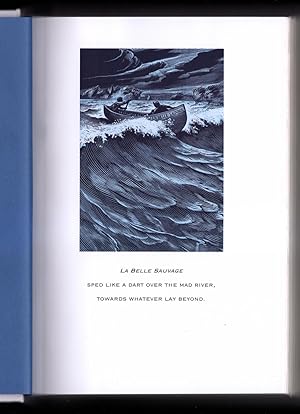
Suffused within that combination of motives and between these two poems we get the story itself. La Belle Sauvage may be divided more or less into two parts: everything leading up to ch 15, The Potting Shed, and everything which follows with the flood, which provides the book its frontispiece-- 


Image result for la belle sauvage frontis


--And the Biblical story of the Flood is certainly the most important of the allusions Pullman plays upon, just as the Fall had been in his earlier work. 


Perhaps the two parts resemble the two poems, the former gradually revealing the "incorrigibly plural" nature of what had appeared to Malcolm a single, sensible world; divided though his world of the priory and the inn may be by the river ceaselessly flowing between, they are just as much linked, since he in his canoe can move freely over it. He also literally reads about and discusses the mysteriously multiple nature of the physical world with Dr Hannah Relf, and so comes into contact with his own destiny as a scholar, as readers will know who have met him in Lyra's Oxford, set after the events of the original His Dark Materials. Dr Relf herself appears as early as The Golden Compass, if I remember right; so that Pullman in these books is continually unfolding the multiple worlds of his characters' stories, weaving together those which most nearly account for the view of the world he seems to care about: one in which people read books and poems and cook Brussels sprouts with crosses cut into the base and care for children, neighbors and strangers alike, and stand up to tyrannical authority.


Anyhow, I've finally sat down and read "Snow," and I'm slowly working through at least Book I of Faerie Queene. I looked but haven't yet been able to find any analyses of Pullman's references to these sources. More to the point, I'm reading La Belle Sauvage through again with Steph, so that will help when I come to say more about all this. 


As I work on essays I'll post more ideas here, and then when I'm through my series of podcasts on EarthBound, Philip Pullman's books will be next!

Feb for Fear and Trembling, Repetition, and some Upbuilding Discourses

Such incalculably great readers, Kierkegaard and his pseudonyms: of Abraham and Job, in Fear and Trembling and Repetition, respectively, and then of the New Testament in his Upbuilding Discourses. Also of the story of the fall in the background, and of Shakespeare brooding over all--conversant with them all with such awe, such gratitude:

"Thanks, once again thanks, to a man who, to a person overwhelmed by life's sorrows and left behind naked, reaches out the words, the leafage of language by which he can conceal his misery. Thanks to you, great Shakespeare, you who can say everything, everything, everything just as it is--and yet, why did you never articulate this torment? Did you perhaps reserve it for yourself, like the beloved's name that one cannot bear to have the world utter, for with his little secret that he cannot divulge the poet buys this power of the word to tell everybody else's dark secrets. A poet is not an apostle; he drives out devils only by the power of the devil" (61).

And such discernment, ever reflecting, yet not quite getting lost in the hall of mirrors, the labyrinths of literature: Abraham here and Agamemnon there, Luke over here and Shakespeare over there...

And such astonishing writers they are! One thing I remembered but could never place, this description of the knight of faith, made me so happy to find at last:

"In the afternoon, he takes a walk to the woods. He enjoys everything he sees, the swarms of people, the new omnibuses, the Sound. Encountering him on Strandveien, one would take him for a mercantile soul enjoying himself. He finds pleasure in this way, for he is not a poet, and I have tried in vain to lure the poetic incommensurability out of him. Toward evening, he goes home, and his gait is as steady as a postman's. On the way, he thinks that his wife surely will have a special hot meal for him when he comes home--for example, roast lamb's head with vegetables. If he meets a kindred soul, he would go on talking all the way...." (39)

And many things I knew nothing about, like the description of the farcical theater like the belly of Jonah's whale which proceeds this passage, have been revelatory to read:

"My unforgettable nursemaid, you fleeting nymph who lived in the brook that ran past my father's farm and always helpfully shared our childish games, even if you just took care of yourself...Then I lay at your side and vanished from myself in the immensity of the sky above and forgot myself in your soothing murmur! You, my happier self, you fleeting life that lives in the brook running past my father's farm, where I lie stretched out as if my body were an abandoned hiking stick, but I am rescued and released in the plaintive purling!--Thus did I lie in my theater box, discarded like a swimmer's clothing, stretched out by the stream of laughter and unrestraint and applause that ceaselessly foamed by me" (166)

Gosh. Or this preface, repeated with variations before each set of Upbuilding Discourses, following the repeated dedication to his father:

"Small as it is, it probably will slip through, since it shifts for itself and goes its way and tends to its errand and discerns its own enigmatic path--until it finds that single individual [hiin Enkelte] whom I with joy and gratitude call my reader--until it finds what it is seeking, that favorably disposed person who reads aloud to himself what I write in stillness, who with his voice breaks the spell on the letters, with his voice summons forth what the mute letters have on  their lips, as it were, but are unable to express without great effort, stammering and stuttering, who in his mood rescues the captive thoughts that long for release..." (53)

"What is not found in the second and third hours may be found in the fourth, or what was found there may again be found in the fourth: that which it seeks, that single individual [hiin Enkelte] whom I with joy and gratitude call my reader, that favorably disposed person who receives the book and gives it a good home, that favorably disposed person who in receiving it does for it by himself and by his acceptance what the temple box by itself did for the widow's mite: sanctifies the gift, gives it meaning, and transforms it into much.
                                                 S. K."            (107)

This all resonates. My word, yes.

And then the helpful remarks of the translators and editors, who point out who that single individual was in particular, how these ideas were developed through drafts and diaries, if one wants to dig into that sort of thing, to get at the truth that is true for someone, or for something, to give some context and some bearing on the categories of language and thought behind the various projects. But the main thing is that they make this writing and reading available, accessible, and what a labor of love that must have been, which I can only hope in some small way to assist with sharing some of it here throughout the year.

Monday, March 26, 2018

Unready Player One - Spoilers

Of course in many ways this is a book I would have liked to have written: for the replete references to games, the popularity and wish-fulfillment. As it is, I could hardly justify skimming it, but I could hardly put it down, either. Beautiful trash. Buttery popcorn.

Is this a book about escaping into nostalgia and fantasy, or embracing their lessons to better live in and seek to understand the real world? Yes.

Ernest Cline wants to have his metaphysical cake and eat it, too, and the result is just not nourishing, while probably not actually corrupting. With so much of popular culture, which is like a media plague, you can't unsee it, and so it's not only the time wasted taking it in, the malaise is in what you feel ever after as you have those images, that impression of futility or macabreness or whatever stamped on you, perhaps molding you, depending on how impressionable you still are--and you become a carrier for it, sharing it, talking about it, or simply influenced by it in subtler ways. It spoils you, and then you spoil it... But I mainly meant spoilers in the usual sense when I put it in the title, so if you want to read the book or see the movie, be warned.

I don't think Ready Player One is as bad as all that. Rather, it seems ambivalent or downright confused about the message implicit in its story, not cynical about the importance or even the possibility of stories or of the meanings they carry.

Throughout the quest for the game creator's Easter egg (the deep yearning for resurrection trivialized, the search for hidden meaning tropified and conventionalized), the main character and his love interest represent two competing ideals. He wants to win the game to take the money, outfit a spaceship, and escape the dying planet earth; she wants to use the money to feed its starving masses and rebuild the crumbling infrastructures of society. But both, in their dedication to the quest and determination to win, have already sunk their sense of self into the creator's dying wish, perhaps with the best of intentions, to tyrannize by love. Not, like Lear, by demanding that they show love and gratitude to him, exactly, but by demanding that they love the same things he loved. Wade and Art3mis devote their time to pastimes and trivia and by extension to Halliday's biography and everything he ever said in an effort to solve the puzzle of his egg-hunt. It's the distortion of the concept of a living tradition of great works, replacing canon with trivia (the way the word canon is often used now in referring to pop-culture works, ie. Star Wars, etc).

Of course they win, interestingly enough thanks to a trinity (three keys in the final door), a resurrection (the extra life coin from the Pacman machine), and a deus ex machina (the aid from his former co-creator, who represents something of the balance the story seems to want to strive for, since he and his wife--successful human relationship!--created the virtual education modules which seem to work so well at raising kids with the ability to track allusions and make snappy repartee). But no real sacrifice has to be made to get there--other than their freedom, which they gave up long ago, and all the time they've sunk into the game, their childhood and much of youth. But we're never given the sense that this was even a choice, they seem to have had only the future at stake, and once it is secured, they live happily ever after as the new god within the machine and the benefactress of the beleaguered planet.

Even if Wade somehow can be imagined to manage to follow in the co-creator's footsteps, using his godlike powers with restraint and for the good of players both in and outside of the simulated universe, and Art3mis to use her funds to teach people to fish, then, on the last page of the acknowledgements, the author basically undercuts the entire message of the book, which was driven home by the final scene of the story. He writes of his sci-fi and pop-culture heroes: "These people have all entertained and enlightened me, and I hope that--like Halliday's hunt--this book will inspire others to seek out their creations." That just seems completely wrong. If all the book is is an extended advertisement for already famous, recent, derivative artists, if Cline like his Halliday is aiming to tyrannize by love, to make us love the things he does, then we had better speak up before the egg-hunt consumes us.