Showing posts sorted by relevance for query pullman. Sort by date Show all posts

Sunday, July 11, 2021

Further Afield: Pullman Bibliographies

Further reading in the literature surrounding Philip Pullman and His Dark Materials, from scholarly criticism to journalism


There's just so much out there. I'm never going to be able to keep track of it all. But I thought I'd go ahead and post this rather than sit on the draft indefinitely, just in case something here might make someone's day the way, for instance, this conversation between Philip Pullman and Ruth Wilson made mine. 

I haven't actually read most of these, but I thought I'd try to keep tabs on them, adding more from time to time here. Send me any others that you find and I'll add them to the list!

For works by Pullman, see this other bibliography


Journalism, articles, interviews

First, you'll probably want to see Pullman's website-- http://www.philip-pullman.com/articles 

The links here arranged by topic are helpful-- https://www.wikiwand.com/en/articles/Philip_Pullman 

A fansite "managed by readers something-of-addicted to the trilogy":  https://www.cittagazze.com/decouverte_en.php?page=11 

And The Guardian has many pieces by and about him-- https://www.theguardian.com/books/philippullman 

Another good starting point (if I do say so myself, having contributed a few of the links) is Fandom: https://hisdarkmaterials.fandom.com/wiki/Philip_Pullman 


Then all the rest. Have at them: 

Aitken, Johanne: https://macblog.mcmaster.ca/fryeblog/making-human-sense-the-changing-influences-of-northrop-fryes-literary-theory-upon-the-literary-experiences-of-children-1957-2007/  

Anderson, Douglas: https://wormwoodiana.blogspot.com/2019/09/philip-n-pullman-haunted-storm-1971.html 

Appleyard, Bryan: https://www.thetimes.com/culture/books/article/the-interview-philip-pullman-on-the-book-of-dust-his-follow-up-to-his-dark-materials-n8s2dlflc?gaa_at=eafs&gaa_n=AWEtsqflEoLl3_frn9KeEdD4j44CUIGHdEvsvad_yVSQ4oRo76K4fZODs7Lxfs_S3G4%3D&gaa_ts=696834fd&gaa_sig=_ytv5XhSGEZR0LHN38ZkalqUnQS3eM3G-n-UnV8PNs-cP3wzcMVFg3KcW4Rjf-Ujr8OO2bpjNZrgs19q7x3Wqw%3D%3D 

argentvive on tumblr: https://www.tumblr.com/argentvive/188239888610/alchemists-in-the-secret-commonwealth 
-- https://www.tumblr.com/argentvive/643067822584496128/philip-pullman-where-does-his-alchemy-come-from 

Backlisted: https://www.backlisted.fm/episodes/100-robert-burton-the-anatomy-of-melancholy 

Bates, Robin: https://betterlivingthroughbeowulf.com/angels-in-pullmans-fantasy/ 

BBC 4: https://www.bbc.co.uk/programmes/articles/1g6rpXFqjcklyq0pwH7GNnV/philip-pullman-s-five-tips-for-writing 

Structure not and tone fundamental, rhetoric and media studies Twitter 13 min eagle man? possibilianism, Van Gogh, Hiawatha, Deutsch fabric  

Berlioz memoirsm diphthong/ligature, Proust, Medtner., Chardin; Goldberg Variations, BWV 988: Var. 1. a 1 Clav.
Angela Hewitt...  Memories Are Made Of This (Remastered 2000) Dean Martin; Blingo Ya Bougie O.K.Jazz, I'll Remember April Gerry Mulligan Quartet, Gerry Mulligan, Shorty Rogers; Beethoven 5th; Berlioz: Les Francs-Juges, Op. 3, H 23d London Classical Players (and the Sleepy Lagoon) 

Blake Society 2018 Lecture: https://www.youtube.com/watch?v=7wbcVXLLChY 

Bodleian: https://www.youtube.com/watch?v=wln6vJig7-4 

Bogle, Joanna: https://crisismagazine.com/opinion/philip-pullmans-dark-materials 

https://bookwitch.wordpress.com/2021/12/26/laurie-frost/ 
-- https://bookwitch.wordpress.com/2025/11/13/the-book-of-dust-the-rose-field/ 

Brown, Charles/T? : [defunct link] http://www.avnet.co.uk/amaranth/Critic/ivpullman.htm -- try https://tamaranth.blogspot.com/2000/08/interview-philip-pullman-august-2000.html 

Buxton, Adam: https://www.adam-buxton.co.uk/podcasts/25 

Calmgrove: https://calmgrove.wordpress.com/2022/12/27/coll/ 
-- https://calmgrove.wordpress.com/2019/10/03/guide/ 
-- https://calmgrove.wordpress.com/2017/11/26/sauvage/ 

Cantor, Matthew: https://www.theguardian.com/books/2025/dec/24/philip-pullman-his-dark-materials 

Chabon, Michael: https://www.nybooks.com/articles/2004/03/25/dust-daemons/ 

Chattaway, Peter: https://www.patheos.com/blogs/filmchat/2007/11/philip-pullman-the-extended-e-mail-interview.html 
--https://web.archive.org/web/20080203160716/https://www.christianitytoday.com/ct/2007/december/12.36.html 
-- https://www.patheos.com/blogs/filmchat/2008/04/the-golden-compass-circles-and-ovals.html 

Christopher, Cassandra: https://digitalcommons.butler.edu/cgi/viewcontent.cgi?article=4462&context=manuscripts 

Cox, Samuel: https://theconversation.com/the-rose-field-takes-philip-pullmans-dust-to-its-philosophical-conclusions-268435 

Dihal, Kanta: http://theconversation.com/how-philip-pullmans-dark-literary-material-shed-light-on-science-and-religion-86238 

Dhillon, Rhiannon: https://www.penguin.co.uk/discover/articles/ask-penguin-podcast-phillip-pullman 

Dirda, Michael: https://www.washingtonpost.com/books/2025/10/31/philip-pullman-rose-field-dark-materials-dirda-review/ 

Dobrinska, Leah: https://blog.bookstellyouwhy.com/philip-pullman-teacher-writer-book-collectors-dream
-- https://blog.bookstellyouwhy.com/collecting-the-works-of-philip-pullman

Elmhirst, Sophie: https://www.nytimes.com/2017/10/12/magazine/philip-pullman-returns-to-his-fantasy-world.html 

Evans, Jules: https://www.philosophyforlife.org/blog/is-philip-pullman-an-atheist-a-pantheist-a-gnostic-a-black-magician-or-what 

Exeter Grimm Tales lecture: https://podcasts.ox.ac.uk/grimm-tales-lecture-philip-pullman 

Flood, Allison: https://www.theguardian.com/books/2017/oct/19/philip-pullman-launches-la-belle-sauvage-sequel-the-book-of-dust-his-dark-materials 

Frisby, Isaac: https://www.seenandunseen.com/pullman-enchantment-and-flat-christmas-world 

Gallimard Jeunesse Romans: https://www.youtube.com/watch?v=lJzwxkzGR_U 

Gardner/BBC (film): https://archive.org/details/bach.-a.-passionate.-life 

Giles, Ann: https://www.theguardian.com/books/booksblog/2007/nov/30/howatrilogybecamealibrary 

Ginocchio, Tony: https://goths.substack.com/p/the-republic-of-heaven-part-1-of  

Goff, Philip: https://iai.tv/articles/panpsychism-and-his-dark-materials-auid-1286 
- https://www.youtube.com/watch?v=AhmQyLUwFpk 
- https://www.youtube.com/watch?v=YIvRaXVFNdI 

Grady, Constance: https://www.vox.com/culture/465906/philip-pullman-rose-field-his-dark-materials-book-of-dust-golden-compass 

Green, Christopher: https://mbird.com/literature/thank-god-for-philip-pullman-a-religious-readers-guide-to-his-dark-materials/ 

Green, Daniel: https://www.youtube.com/watch?v=BraSGHZPNNk 

Green Templeton "Whose Story is it?": https://www.youtube.com/watch?v=wBtm_M8PaIg

Grossman, Lev: https://www.theatlantic.com/magazine/archive/2025/12/philip-pullman-his-dark-materials-book-of-dust-fantasy-trilogies/684612/ 

Haydon, Caroline: https://www.independent.co.uk/news/education/education-news/why-philip-pullman-wants-to-teach-children-about-atheism-6107883.html 

Higgins, Charlotte:  https://www.theguardian.com/culture/charlottehigginsblog/2008/sep/01/postholidayreadinglist 

Hitchens, Peter: https://firstthings.com/the-philip-pullman-dilemma/ 

Horobin, Simon: https://theconversation.com/his-dark-materials-how-to-decode-the-storys-linguistic-secrets-127459 

How to Academy (w/ McGilchrist): https://www.youtube.com/watch?v=bgZwrfraLMY 

Jukes, Peter: https://aeon.co/essays/a-rare-interview-with-philip-pullman-the-religious-atheist 

Kean, Margaret: https://podcasts.ox.ac.uk/philip-pullman-lyras-oxford-bodleian-library-masterclass 
- interviewing Philip Pullman: Lyra's Oxford, Bodleian Library Masterclass
-- https://writersinspire.org/content/philip-pullmans-his-dark-materials 

Kermode, Frank: https://www.lrb.co.uk/the-paper/v32/n10/frank-kermode/improving-the-story 

Lauritzen, Paul: https://www.commonwealmagazine.org/philip-pullmans-dark-material 

Leith, Sam: 
https://www.thetimes.com/culture/books/article/rose-field-book-dust-volume-3-philip-pullman-review-bwwbddsl5?gaa_at=eafs&gaa_n=AWEtsqfOdqqxnb1aDv9nPQcIYKKyG-u6Am4q7Yxq36_VV0pFolPpJ7zc0M609B4yaOY%3D&gaa_ts=698b7764&gaa_sig=z6Jq50m8XXzl--adlIv2zHE3YsH2su1JWxc-V16Q0icLep94_EA7GoY0a4irqKOVCb0npZaT14SLt7rZbY5JAA%3D%3D 
-- https://www.thetimes.com/culture/books/article/philip-pullman-when-i-write-nothing-bad-can-happen-3lqk2l86h 
-- https://www.telegraph.co.uk/books/what-to-read/philip-pullmans-book-dust-la-belle-sauvage-review-rich-dreamlike/ 

Lightspeed Magazine/ wired.com Geek's Guide to the Galaxy podcast:  https://www.lightspeedmagazine.com/nonfiction/interview-philip-pullman/

Maloney, Daniel: https://web.archive.org/web/20080302042231/https://firstthings.com/article.php3?id_article=2181 

Mair, John, and Davies, Mark at St Barnabas Feb 2022: https://www.youtube.com/live/WhbvkC3QZLY Ten Oxford Authors: Ten Literary Walks 
Bishop kirk Ms c 17 min Alice fell press freedom wild exuberance of imagination nursery rhymes raven poe is that all there is  

Masters, Kristin: https://blog.bookstellyouwhy.com/bid/230045/Philip-Pullman-in-Pictures 

Masson, Scott J: https://www.bethinking.org/culture/philip-pullmans-his-dark-materials 

McGrath, Alister: https://www.youtube.com/watch?v=YC-aE5CaMS0 

Mechanic, Michael: https://www.motherjones.com/media/2012/11/interview-philip-pullman-grimm-fairy-tales-his-dark-materials-book-dust/ 

Medby, Ingrid: https://blogs.cardiff.ac.uk/arctic-relations/the-idea-of-north-and-his-dark-materials/ 

Mind Chat, Goff: youtube.com/watch?si=sdbyjxZw0smVnf_2&v=AhmQyLUwFpk&feature=youtu.be 

Miller, Laura: https://www.newyorker.com/magazine/2005/12/26/far-from-narnia 
- https://slate.com/culture/2019/10/phillip-pullmans-secret-commonwealth-audiobook-read-by-michael-sheen.html 

Moreton, Cole: https://www.dailymail.co.uk/home/event/article-6114943/Im-congenial-melancholic-Philip-Pullman-keeps-writing.html 

New Scientist: https://www.youtube.com/watch?v=i4hnaac7ezs (cited not cited by reddit) 

Nixon, David: https://www.solas-cpc.org/engaging-with-pullman-part-one-why-ill-be-watching-his-dark-materials-and-so-should-you/ 

Open University: https://www.youtube.com/watch?v=KndzWNBxGPI&t=7s - Borderland lecture

Ordway, Holly: https://www.seenandunseen.com/holly-ordway-re-enchanting-middle-earth 

Oxford Botanic Garden audio tour: https://podcasts.ox.ac.uk/21-philip-pullman 

Oxford Story Museum: https://www.storymuseum.org.uk/1001-stories/his-dark-materials 
- https://www.theguardian.com/uk-news/2020/mar/14/oxford-story-museum-childrens-book-lyra-alethiometer for the image of PP dressed as Long John Silver
- https://www.storymuseum.org.uk/1001-stories/four-tales 

Oxford Union: https://www.youtube.com/watch?v=-xjKjOaOWR0 

Oxford Writers House Talks: How And Why I Write: Philip Pullman, Mary Loudon, Jane Griffiths, and Fintan Calpin in conversation: https://podcasts.ox.ac.uk/how-and-why-i-write-philip-pullman-mary-loudon-jane-griffiths-and-fintan-calpin-conversation 

Ozment, Nick: https://www.blackgate.com/2017/01/29/ozs-bag-of-holding-my-beef-with-lev-grossmans-the-magicians-and-philip-pullmans-his-dark-materials/ 

PA: https://www.irishexaminer.com/breakingnews/entertainment/philip-pullman-surprised-and-honoured-at-knighthood-894517.html 

Parsons, Matthew: https://matthewjrparsons.com/tag/philip-pullman/ 
-- which links in Vonnegut's Timequake and the fascinating "Lemma Science" to The Rose Field

Paulson, Steve: https://www.ttbook.org/interview/his-dark-materials-author-philip-pullman-consciousness-all-things 
-- https://nautil.us/why-philip-pullman-is-obsessed-with-panpsychism-237726/?_sp=97971526-8c6d-4135-abd0-00849de1455b.1697441702066 

Perrin, Tom: https://www.publicbooks.org/coming-of-age-with-philip-pullman/ 

Poole, Kristen: https://www.exeter.ox.ac.uk/professor-kristen-poole-discusses-myth-fantasy-and-philip-pullmans-imagination/ 
-- https://www.youtube.com/watch?v=MIvtP5fFvVo 

Quayle, David: https://quavid.wordpress.com/2020/04/23/the-secret-commonweath-the-invisible-library/ 

Quinn, Annalisa: https://www.npr.org/2017/10/19/557189779/philip-pullmans-realm-of-poetry-and-inspiration 

Ramirez, Janina: https://shows.acast.com/artdetective/episodes/philippullman 

Razzall, Katie: https://www.bbc.com/audio/play/w3ct8c3y 

Reddit: https://www.reddit.com/r/hisdarkmaterials/comments/ppkpom/literary_analysis_of_fake_books_realworld/ 

Reimann, Matt: https://blog.bookstellyouwhy.com/philip-pullman-impassioned-storyteller-for-all-ages 

Renton, Jennie: https://textualities.net/jennie-renton/philip-pullman-interview 

Richards, Parker: https://theamericanscholar.org/philip-pullmans-unorthodox-liberalism/ 

Ross, Stephen: https://www.equip.org/articles/exposing-his-dark-materials/ 

Saunders, Martin: https://www.premierchristianity.com/home/the-gospel-according-to-pullman-/1904.article 

Scholes, Lucy: https://www.prospectmagazine.co.uk/culture/71838/philip-pullman-beyond-childhood-and-evil-the-book-of-dust 

Sheen, Michael: interview at the end of The Rose Field audiobook -- amazing
- https://www.youtube.com/watch?v=FbzFpTfong4 

Sholl, Lucy: https://www.jerichocentre.org.uk/about_jericho/about_arts_item/exploring-lyras-jericho 

Society of Authors: https://www.youtube.com/watch?v=cTyY8amuGZM 

Southbank Centre: https://www.youtube.com/watch?v=Z3NVBJL34kQ 

Spanner, Huw. www.spannermedia.com/interviews/Pullman.htm and https://highprofiles.info/interview/philip-pullman/

Thorpe, Vanessa: https://www.theguardian.com/books/2010/apr/04/teenage-fiction-cult-angels 

Tucker, Nicholas: http://booksforkeeps.co.uk/issue/225/childrens-books/articles/an-interview-with-philip-pullman 

Unbelievable, Brierly/ Spufford: https://music.youtube.com/watch?v=nq2xqpspkzc 
-- https://www.premierunbelievable.com/unbelievable/unbelievable-philip-pullman-on-the-historical-jesus/11861.article - against gnosticism Jesus as storyteller response without reading the book  

Ward, Michael: http://www.michaelward.net/assets/documents/74/Lewis_and_Pullman.pdf 

Waters, Sarah: https://shakinspearians.wordpress.com/2019/08/02/energising-revitalising-or-philip-pullman-on-why-burtons-anatomy-matters/ 

Waterstones: https://www.youtube.com/watch?v=MOk_669jUQM 
-- https://www.youtube.com/watch?v=mdaIInJDk4s 

Watkins, Tony: http://www.tonywatkins.co.uk/media/literature/interview-with-philip-pullman-from-2004/ 

Williams, Rowan: https://www.newstatesman.com/culture/2017/10/book-dust-philip-pullman-might-not-be-fond-church-he-intensely-spiritual 

X/Twitter: https://x.com/PhilipPullman/status/1281201187279245315 

Young, Cathy: https://reason.com/2008/02/26/a-secular-fantasy/ 

Zarley, B. David: https://web.archive.org/web/20190923212331/https://www.pastemagazine.com/articles/2018/10/daemon-voices-by-philip-pullman.html 


Books and Chapters
  

Barfield and Cox, eds: Critical Perspectives on Philip Pullman's His Dark Materials: Essays on the Novels, the Film and the Stage Productions 

Beahm, George: Discovering the Golden Compass: A Guide to Philip Pullman's Dark Materials  

Bobby, Susan R: Beyond His Dark Materials: Innocence and Experience in the Fiction of Philip Pullman 

Butler and Halsdorf, eds: Philip Pullman (New Casebooks, 24) 

Carter James: Talking Books: Children’s Authors Talk about the Craft, Creativity and Process of Writing (London: Routledge, 1999), 185.

Colbert, David : The Magical Worlds of Philip Pullman 

Duncan, Diane: "Philip Pullman Parallel worlds and penny dreadfuls," in Teaching Children's Literature Routledge 2009

Freitas, Donna and King, Jason: Killing the Imposter God: Philip Pullman's Spiritual Imagination in His Dark Materials 

Frost, Laurie: Philip Pullman's His Dark Materials - The Definitive Guide (aka Elements of HDM)

Gardner, John Eliot: Music in the Castle of Heaven (references, according to https://www.theguardian.com/books/2013/oct/30/music-castle-heaven-js-bach-john-eliot-gardiner )

Gray, William: Death and Fantasy: Essays on Philip Pullman, C. S. Lewis, George MacDonald and R. L. Stevenson

Gresh, Lois: Exploring Philip Pullman's His Dark Materials: An Unauthorized Adventure Through The Golden Compass, The Subtle Knife, and The Amber Spyglass 

Gribben, Mary and John: The Science of Philip Pullman's His Dark Materials 

Gruner, Elisabeth Rose: "Leading through Reading" in Frontiers in Spiritual Leadership: Discovering the Better Angels of Our Nature   

Leith, Sam: The Haunted Wood: A History of Childhood Reading 

Lenz and Scott, eds: His Dark Materials Illuminated: Critical Essays on Philip Pullman's Trilogy 

Miesel and Vere: Pied Piper of Atheism: Philip Pullman and Children's Fantasy 

Mooney, Bel: Devout Sceptics: Conversations on Faith with Bel Mooney (London: Hodder & Stoughton, 2003) 

Mountford, Brian: Christian Atheist: Belonging without Believing

King, Shelley: The Subtle Art of Reading Philip Pullman 

Poole, Kristen: Philip Pullman and the Historical Imagination: Seventeenth-Century Literature, Science, and Religion in His Dark Materials and The Book of Dust 

Simpson, Paul: The rough guide to Philip Pullman's His dark materials 

Speaker Yuan, Margaret: Philip Pullman 

Squires, Claire: Philip Pullman, Master Storyteller: A Guide to the Worlds of His Dark Materials 

Tucker, Nicholas: Darkness Visible: Inside the World of Philip Pullman 


Academic/Peer-Reviewed Papers (see also--ugh--academia.org)

Antsyferova, O. Yu. (2023). Dualisticheskoe pereosmyslenie khristianskogo mifa Philipom Pullmanom [Dualistic Rethinking of the Christian Myth by Philip Pullman]. Izvestiya Uralskogo federalnogo universiteta. Seriya 2: Gumanitarnye nauki, 25(1), 151–165. https://doi.org/10.15826/izv2.2023.25.1.010

Blair, Kirstie. “INTRODUCTION TO SPECIAL ISSUE OF LITERATURE AND THEOLOGY: CHILDREN’S LITERATURE AND THEOLOGY IN THE TWENTIETH AND TWENTY–FIRST CENTURIES.” Literature and Theology, vol. 30, no. 2, 2016, pp. 125–30. JSTOR, http://www.jstor.org/stable/44490838. Accessed 17 Feb. 2026. and https://dspace.stir.ac.uk/retrieve/348c856b-2b52-48d9-8484-5953a38f3a40/Blair_LT_2016.pdf

Boucher, G.M.; Devonport-Ralph, C. Philip Pullman and Spiritual Quest. Literature 2022, 2, 26-39. https://doi.org/10.3390/literature2010002 at https://www.mdpi.com/1488480

Burton, Emanuelle. “MORAL HORROR AND MORAL MATURITY: PHILIP PULLMAN’S THEOLOGICAL ANTHROPOLOGY FOR A GODLESS WORLD.” Literature and Theology, vol. 30, no. 2, 2016, pp. 198–214. JSTOR, http://www.jstor.org/stable/44490843. Accessed 17 Feb. 2026.

Cantrell, Sarah. “Letting Spectres In: Environmental Catastrophe and the Limits of Space in Philip Pullman’s His Dark Materials,” Children’s Literature Association Quarterly 39, no. 2 (2014) 234

Garrahy, Jessica: https://openjournals.library.sydney.edu.au/LA/article/view/5004/5702

Gooderham, David. "Fantasizing It As It Is: Religious Language in Philip Pullman's Trilogy, His Dark Materials." Children's Literature, vol. 31, 2003, p. 155-175. Project MUSE, https://dx.doi.org/10.1353/chl.2003.0009.

Gray, William (2007) "Pullman, Lewis, MacDonald, and the Anxiety of Influence," Mythlore: A Journal of J.R.R. Tolkien, C.S. Lewis, Charles Williams, and Mythopoeic Literature: Vol. 25 : No. 3 , Article 11.

Greenwell, Amanda M.  “‘The Language of Pictures’: Visual Representation and Spectatorship in Philip Pullman’s His Dark Materials,” Studies in the Novel 42, nos. 1–2 (2010): 104. 

Holderness, Graham  ‘The Undiscovered Country’: Philip Pullman and the ‘Land of the Dead’, Literature and Theology, Volume 21, Issue 3, September 2007, Pages 276–292, https://doi.org/10.1093/litthe/frm025

Julien, Pauline: https://paulinejulien1.wixsite.com/website/post/believable-fantasy-world-building-and-symbolism-in-northern-lights-by-philip-pullman-1995 

Macaskill, Grant  Dead Gods and Rebel Angels: Religion and Power in Philip Pullman's His Dark Materials and Hal Duncan's The Book of All Hours. Cultural Encounters v. 5, n. 1  (01 December 2009) : 7-32

McCulloch, Fiona. “‘Refugees Returning to their Homeland’: Regaining Paradise in His Dark Materials,” in To See the Wizard: Politics and the Literature of Childhood, ed. Laurie Ousley (Newcastle: Cambridge Scholars Publishing, 2007), 159.

Moruzi, Kristine: https://link.springer.com/article/10.1007/s10583-004-2189-7 

Oram, William: Pullman’s Matter: Lucretius and Milton in His Dark Materials,” Journal of the Fantastic in the Arts 23, no. 3 (2012): 418–36.

Oziewicz, Marek and Hade, Daniel (2010) "The Marriage of Heaven and Hell? Philip Pullman, C.S. Lewis, and the Fantasy Tradition," Mythlore: A Journal of J.R.R. Tolkien, C.S. Lewis, Charles Williams, and Mythopoeic Literature: Vol. 28 : No. 3 , Article 4.  

Padley, J., Padley, K. ‘A Heaven of Hell, a Hell of Heaven’: His Dark Materials, Inverted Theology, and the End of Philip Pullman’s Authority. Child Lit Educ 37, 325–334 (2006). https://doi.org/10.1007/s10583-006-9022-4 

Pipin, Tina https://books.google.com/books?hl=en&lr=&id=HA_tEAAAQBAJ&oi=fnd&pg=PA175&dq=philip+pullman&ots=3Qod3FY9Na&sig=PO1__k1Hbna35_cKpHdYirIw2wk 

Syson, Antonia:  http://www.oxfordscholarship.com/view/10.1093/acprof:oso/9780190610050.001.0001/acprof-9780190610050-chapter-11 

Toth, Zsuzsanna: https://www.academia.edu/27964999/_I_don_t_think_the_world_was_ever_disenchanted_It_still_is_enchanted_Excerpts_from_an_Interview_with_Philip_Pullman_Part_1_?sm=b&rhid=38134907210 
-- https://www.academia.edu/30464646/_I_don_t_think_the_world_was_ever_disenchanted_It_still_is_enchanted_Excerpts_from_an_Interview_with_Philip_Pullman_Part_2_?sm=b&rhid=38134907210 

Walsh, Elizabeth. 2023. “His Dark Materials Among the Displays, the Pitt Rivers Museum, December 12, 2022 to December 31, 2023.” Museum Anthropology 00 (0): 1–3. https://doi.org/10.1111/muan.12278. 

Woollard, Anthony Philip Pullman and the Republic of Heaven. Modern Believing 45, 47-56(2004).
DOI:10.3828/MB.45.2.47


Panels, Essays, and Theses

Berry, Esther: https://openjournals.library.sydney.edu.au/SSR/article/view/118/138 

Chelioti, Elena: https://etheses.bham.ac.uk/id/eprint/4277/1/Chelioti13PhD.pdf 

Doucet, Sibylle: https://theses.hal.science/tel-03693860/file/Doucet_Sibylle_2021_ED520_inc.pdf 

Haneline, Douglas: https://muse.jhu.edu/article/223821/pdf 

Hartney, Christopher : Imperial and Epic: Philip Pullman’s Dead God  https://openjournals.library.sydney.edu.au/SSR/article/view/116/136 

Hsu, Hsiao Hsien: https://repository.essex.ac.uk/19669/1/HHS%20thesis%202017.pdf 

Javaheri, Zohre, "Subjectivity in Young Adult Literature (Philip Pullman's His Dark Materials, Marjane
Satrapi's Persepolis" (2018). Electronic Thesis and Dissertation Repository. 5208.
https://ir.lib.uwo.ca/etd/5208 

Klinkenberg, Marie: https://matheo.uliege.be/bitstream/2268.2/10209/4/Version%20finale%20PDF.pdf 

O'Sullivan, Keith: In a Tradition of Republican Revolution: Romanticism and Philip Pullman’s His Dark Materials https://doras.dcu.ie/22584/1/Keith%20O%20Sullivan.pdf 

Telkamp, Durba: https://openaccess.leidenuniv.nl/bitstream/handle/1887/33855/A%20Myth%20of%20Loss.pdf?sequence=1 

Trunnel, Ethan: Philip Pullman and the Specter of Depression https://digitalcommons.usu.edu/researchweek/ResearchWeek2017/Session1OralPresentations/1/ 

Waddell, Heather: https://ida.mtholyoke.edu/server/api/core/bitstreams/8cc75489-ae51-4d3a-a7a8-e1752423627d/content 

Wednesday, January 30, 2019

Critical Bearings: His Dark Materials Illuminated, Edited by Millicent Lenz and Carole Scott


Overview

His Dark Materials Illuminated, edited by Millicent Lenz and Carole Scott (Wayne State UP, 2005), is an intriguing but frustratingly uneven study of Philip Pullman's work. The essay collection carries strong advance praise from several relevant scholars, and it has been favorably reviewed in at least one academic journal, but I found most of the essays to be missed opportunities on the part of their contributors to engage in a serious way with Pullman.

As I am not within the scholarly milieu, not writing specifically for other scholars, nor particularly interested in seeking acceptance for my work within their publications, my opinions may be rather peripheral, and shouldn't carry too much weight. Nevertheless, as I'm reading and thinking carefully about how best to learn from and perhaps to teach His Dark Materials, besides reading Pullman's own comments in essays and interviews and brushing up on some of his most conspicuous sources and literary touchstones, I've also been wading into the existing scholarship, to see if there is anything bright and shiny there worth stealing (with proper attribution, of course) and bringing back to a wider audience. So let's begin with HDM Illuminated. For along with its dross of shortcomings--which may well just be in the eye of this beholder, or endemic to the scholarly-essay-compendium form, or both--there is some gold here.

Following the editor's introduction, "Awakening to the Twenty-first Century: The Evolution of Human Consciousness in Pullman's His Dark Materials," which sounds promising, but proves a little breathless and new-agey, the collection is organized into three sections:

- Reading Fantasy, Figuring Human Nature
- Intertextuality and Revamping Traditions
- Pullman and Theology, Pullman and Science Fiction

Which, unfortunately, are about as faddish and baggy as they sound. There follow biographical and bibliographical notes. Each section is prefaced with an overview; individual essays do not have abstracts, and most carry only a few works cited and endnotes. Still these tangential remarks, citations (especially from interviews and speeches of Pullman's I wasn't previously aware of), and bibliographical signposts proved to be some of the most interesting material in the book.

Frankly, I don't feel like I actually learned very much about Pullman's story, themes, or characters--the things I care most about--nor about the process of his own reading, writing, and revision--the things I wanted to know more about. Most of the authors in the collection seem to treat Pullman's story as simply an experimental case study for whatever theoretical perspective or research topic they are concerned with: ideology, reader-response, various takes on theology, etc. Some of this, again, is built into such a collection and into the broader academic discourse, with its publishing imperative; some of this looseness, with most essays talking past one another from their rather arbitrary arrangement among the three sections, could also be the effect of the editors' choices. I'd be interested to see the original call for papers; I'm in contact with and hope to talk to at least one or two of the authors, though sadly before the book saw publication, Millicent Lenz, the editor, passed away.


Thoughts on the essays

Awakening to the Twenty-first Century: The Evolution of Human Consciousness in Pullman's His Dark Materials, by Millicent Lenz

I have my critiques of this piece, as of the collection as a whole, but I am appreciative of the work Lenz does here to establish Pullman as a subject for serious study. Perhaps it would be too pejorative, then, to note that she undercuts that seriousness by taking a quote from "New Dimensions Radio" for her epigraph, alongside a passage from The Amber Spyglass. The latter, as she hasten to point out, is the winner of the prestigious Whitbread Prize; the former, a self-help website's glib quote of the day. After all, my own project is engaged with just such bridge-building between scholarship and popular culture; perhaps we just don't have the same taste in listening. Lenz's dedication to the project of Pullman scholarship is evidenced by her having previously published an essay on Pullman in Alternative Worlds of Fantasy Fiction, co-edited with Peter Hunt, and here she continues to build on the idea of a creative evolution of consciousness, albeit without grounding that endeavor in neuroscience or even psychology, nor explaining why she does not do so. Besides citing Pullman's Arbuthnot lecture (which I haven't been able to track down), among other statements by the author from across his series as well as outside of it, Lenz draws on studies of Wagner and PB Shelley, as well as stray quotes from Thoreau and Beowulf, to make her case for Pullman's mythic storytelling as a representation of and blueprint for enlightenment, in the intellectual as well as the spiritual sense. It's a convincing enough argument, though I'm already partial to the thesis and thus would have liked to see less enthusiastic skipping around and more sustained analysis of the actual consequences of such a mode of consciousness. I think Lenz glosses over the inherent contradictions, or at any rate the paradox, of her faith in all of us undertaking our own process of mythopoesis, not only cheering on Lyra and Pullman in theirs. Instead of squarely addressing the requirement for Will and Lyra to return each to their real world, or to tell true stories in the world of the dead, or to account for less persuaded readers' claims that God is still a vital part of their lives--and not only the "Echoes in the space where God has been," in Pullman's provocative phrase, which she seems to believe is now normative or at least desirable--Lenz's essay concludes by opening the floor to the other authors. Her admirable invocation to "enrich the quotient of Dust in our literary universe" (13) would land with more force if Lenz had, if only in a footnote, wrestled a little more with what that multifaceted mote of a word might mean.


Reading Dark Materials, by Lauren Shohet

Eschewing a flashy two-part title--the only piece in the collection which dispenses with this badge of the contemporary academic essay--and mercifully lacking any overt theoretical framework, Shohet's "Reading" is also one of the strongest in the book. From an opening densely packed with well-chosen quotes from HDM, Shohet puts her finger on the implications of innocence and experience "in the modes of reading...and the stakes of good reading for the trilogy's interrelated models of art, identity, and ethics" (23). In this essay, she does what I am trying to do: not to impose a reading on Pullman, but to understand the reading which his story, by its story, content, form, and presuppositions, is teaching. To do so, I agree with Shohet that we need to build upon some of those implicit presuppositions: "Like Renaissance allegory, HDM creates a legible world that demands adequate reading for more than cognitive reasons...symbolic (exploring Lyra and Will's relationship as the relations between art/storytelling ['the Lyric'] and desire/action ['Will']); moral (plumbing the nature of persons and communities in the different worlds the novels depict); and 'anagogical' or apocalyptic (the battle between opposing supernatural forces that includes resolving the problem of death)." She points us to Hamilton's work on Spenser if we want to know more about allegory, but immediately dives back into the story, picking up on Dr Lanselius' hint of a Renaissance background for the alethiometer. Giving continual points of reference in Milton, Shohet elegantly negotiates the crucial problems of death, erotic love, and metaphysical vitalism in Pullman, before closing with a humbler and yet more effective appeal to hear "The Republic of Heaven" in the bells that close the story.


Second Nature: Daemons and Ideology in The Golden Compass, by Maude Hines

Drawing on Louis Althusser, Michel Pecheux, and Pierre Bourdieu, the essay applies the claim "it is impossible to get outside of ideology" to Pullman's work (37). While it may be compelling sociology, it doesn't have much to teach us about the story, which actually seems concerned with something like human nature--deeply connected to the material world--capable of transcending ideology, or at any rate constructing a novel, continually renovating ideology resting upon the possibility of measuring the truth and telling true stories. In particular, Hines explores the way in which Lyra's world treats daemons as normative, while to us they are fantastic. She makes some uncomfortable parallels, such as between the racist pseudosciences of phrenology and physiognomy and Lyra's ability to read peoples' emotions and social status through their daemons, or between her near brush with intercision and gang rape or castration, which are implicit in the text, but do not add up to significantly aid our understanding of what these things, shocking in themselves, are doing within the story. To me, they are plainly metaphors evoking human nature and evil, respectively, both of which seemed ruled out by Hines' ideological presuppositions. What I take to be Hines' central claim, when she is speaking of the witches' view of Lyra's destiny: "Destiny works like ideology here; nature, like free will," actually seems interesting, but it is confused and not developed by making references to "familiar fairy-tale narrative" and "Freudian family romance," rather than looking closely at what Lyra understands of her destiny, and what role her daemon plays in it (40).. In short, what actually happens in the story is much more interesting.


Dyads or Triads? His Dark Materials and the Structure of the Human, by Lisa Hopkins

Another intriguing title, and as I read over the examples of twos and threes, of which a few are pretty interesting--the conflict between Will and the man he kills because "neither of them saw the cat" (though you might say that neither of them saw their daemons, either), or the claim that "there are in fact three events that could be interpreted as constituting this betrayal" (52, though I disagree with the three she suggests being the only candidates)--I was mostly looking for Hopkins to discuss the key passages where Lyra and Will intuit that, besides their physical bodies and their daemons, "'there must be another part, to do the thinking!'" and where, when they ask her about it towards the end of the book, Mary Malone tells them, '''St Paul talks about spirit and soul and body.'" She winds up, "'So the idea of three parts in human nature isn't so strange.'" I felt the same could be said for this essay: So what? Hopkins ends right where the real work would begin, with questioning and unpacking these claims about the "triune nature of the human" (55). How, since it is an idea in Augustine (and in Plato and Aristotle, for that matter, while the children's initial insight sounds almost Cartesian) how is it that this "fundamentally cuts against" the complex doctrine of the Trinity, which Augustine, following his read of Paul, was influential in developing? Even without firsthand knowledge of the philosophers and theologians, a quick search would have pointed Hopkins to the relevant Bible verses, so that we could at least begin to think about the theology embedded in Pullman's story, as Mary plainly invites us to do. And then to top it off, the "Alethiometer" feature on the Random House website, cited in the notes, seems to be defunct. But I can't blame that on Hopkins.


Northern Lights and Northern Readers: Background Knowledge, Affect Linking, and Literary Understanding, by Margaret Mackey

I was excited about this one, again, because of what I was hoping and expecting to find in it. Lenz, in her intro, notes "Margaret Mackey's 'Playing in the Phase Space'[...] comments on Pullman's use of the concept and explores the textual 'play' that crosses media boundaries" (14). I wanted to hear more about play in Pullman's work, the ludic, if you like, as it relates to reading Pullman, but instead got a playful essay with practically nothing to say about Pullman's story. Instead, Mackey describes driving past hay trucks in winter, connects this to Dust and the North, says a little about the presuppositions and background knowledge readers bring to texts and a little about studies to that effect, hers and Gelertner's, and their relation to the classic reader-response literature. It would be a useful essay for someone writing a paper in an education class, I imagine, but it doesn't yield any new insights into Pullman. Alas, I can't even find a copy of her other essay anywhere.


Pullman's HDM, a Challenge to the Fantasies of JRR Tolkien and CS Lewis, with an Epilogue on Pullman's Neo-Romantic Reading of Paradise Lost, by Burton Hatlen

Pullman's Enigmatic Ontology: Revamping Old Traditions in HDM, by Carole Scott

"Without Lyra we would understand neither the New nor the Old Testament": Exegesis, Allegory, and Reading The Golden Compass, by Shelley King

Rouzing the Faculties to Act: Pullman's Blake for Children, by Susan Matthews

Tradition, Transformation, and the Bold Emergence: Fantastic Legacy and Pullman's HDM, by Karen Patricia Smith

In line with the approach traced by Shohet, though not quite with her insight into Pullman's work, the five essays in the middle section of the book address themselves to the task of elucidating Pullman's use of canonical literary sources. I consider them together here for the simple reason that though each treats a different source or cluster of sources, the upshot of each of these essays is pretty much the same: readers with a serious interest in Pullman, who are fired by his imagination and want to understand his work as fully as possible, and thus to see some of what inspired him, in turn, would do best to read those major sources for themselves. The essays are fine as secondary texts attesting to and gathering evidence of influences Pullman himself has repeatedly avowed his indebtedness to, but they do little to synthesize the effects of these influences taken together, which would help bring out and begin accounting for the complex tensions at work between them in his work as a whole. For an admirable work of that kind, I recommend Laurie Frost's encyclopedic The Elements of His Dark Materials, which carries a laudatory foreword by Pullman himself. (There are no doubt other dissertations and monographs out there by this time--I've seen references to a work by Gray which looks fascinating, but I have yet to read it.)

At around twenty pages each, Hatlen's and King's entries are the most substantial in terms of length in the entire collection. Lacking sufficient focus, though, they read like the outlines of book-length studies, ranging over interesting material and raising intriguing connections without contributing anything substantially new about the significance of Pullman's use of his sources. Hatlen makes the claim, echoed by many Lewis scholars, such as Dickieson and Ward, that Pullman's avowed distaste for the Narnia books does not prevent him from producing "a kind of inverted homage to his predecessor." Fair enough, and a topic well worth treating further, but Hatlen's essay instead tries to rope in Tolkien and Milton as well. Unfortunately, Hatlen discredits himself as a reader of Tolkien at the outset, with the dismissive, "Tolkien's achievements as a literary scholar were relatively modest" (76). Relative, perhaps, only to his impact as a novelist, but even that is by no means obvious, given the importance of his two great essays, "Beowulf: The Monsters and the Critics," and "On Fairy-Stories." The discussion of Milton may be valuable as a summary of the main currents of formidable scholarship by Fish, aligned with Lewis' orthodox read of Paradise Lost, and Empson, aligned with Pullman's Blakean conception, but it does little to illuminate Pullman's story.

King's essay revolves around a conceit much less commonly remarked upon than Hatlen's, connecting a "theological scholar-exegete," Nicholas of Lyra, with our main character, as well as noting her surname's reference to Dante (112). Though acknowledging that the connection between the names may be spurious, or, as she puts it, "merely serendipitous," King spins out an expanded version of Shohet's insight about layers of meaning with respect to medieval exegesis. She references the alethiometer and other characters' names in a somewhat scattered way, but also makes important connections to the Christian fantasist in whose shadow the Inklings themselves once stood, George MacDonald, and to an instance of dust imagery in Bunyan's epochal Pilgrim's Progress. One more cogent argument concerns the minor prophetic undertone's of Will's father's mantle, and his understanding of his mother's use of that phrase. Despite its somewhat playful indulgence of breadth at the expense of depth (one I can relate to), King's piece proves to be one of the richest and liveliest in the collection. Not least, because it winds up with commentary from Pullman on one of the least known of his key sources, Kleist's "On the Marionette Theatre," from an interview the full transcript of which is evidently no longer available.

Placed between the two longer essays, Scott's suffers from being too short. She takes on too much for ten pages: "This essay will explore how Pullman has used his three major literary sources--Milton, Blake, and the Bible--to reinterpret the ontology of humankind's moral and ethical universe, and to redefine humankind's quest for a meaningful purpose in life and the individual's responsibility in defining good and evil" (95). Again, Shohet tackles similar themes, but through the lens of imagery of reading does a much better job limiting her essay to a manageable scope. Inevitably, without a similarly focused image or question, Scott can do little more than present broad the broad strokes of what would make an interesting book in its own right (one someone may well have written by now). Though citing a number of relevant passages from Pullman as well as those three sources, countless others are left out. For one crucial example, perhaps because it is discussed, albeit briefly, by King, Asriel's discussion of Genesis does not figure in Scott's essay. Fresh fields of study, such as the witches' beliefs about Yambe-Akka, or shamanism, are referenced only glancingly, but would have represented a much better use of Scott's evident acumen. Tasked with completing the work of editing the collection after Lenz' passing, though, she no doubt had many other pressing concerns.

Matthews brilliantly concentrates her essay on Pullman's debt to just one author, William Blake. (Though in noting the strangeness of the mulefa, she can't pass up references to Gulliver's Travels and The Lord of the Flies.) Besides analyzing passages of various poems from across Blake's cosmos, providing a jumping-off point for further reading, Matthews ties the verbal and thematic echoes she discovers there in Blake back to equally well-chosen moments in Pullman. Thus, beyond the familiar sweeping statements about innocence and experience, we get some new insights into the importance of the body and sexuality, into daemonic separation and settling, and into how these relate to the narrative voice in the novel. That storytelling voice is perhaps Pullman's least appreciated master-stroke, one he muses on in his essays frequently, and Matthews begins to show a way to investigating it further, noting its indebtedness to poetry through allusions and epigraphs as well as celebrating its prose: "drawing in its imaginative energy on the soaring movement of comic heroes in its battles and journeys, but also, like Blake's writing, demanding access to the key myths of its culture" (133). Her closing critique of HDM's "linear reading...that loses some of the dialectical power of opposition and contraries," is well taken, hinting at the tension between Pullman's statements about the freedom of the reader and the evident didactic turns his story seems to take. However, I would want to dig deeper into the way in which Pullman illustrates a world saved by innocence as well as experience before buying into Matthews' argument fully. My only other quibble is that the essay would also have benefited from at least acknowledging the important role of Blake's illustrations, since Pullman's delight in, and dabbling in, visual art is well known.

Smith takes the opposite tack, cobbling together an agglomeration of references to recent generations of YA fantasy authors whose work Pullman has most likely never read. She imparts a measure of structure to this attempt to map a genre he disavows onto Pullman through a framework of "Five Key High Fantasy Conventions," more or less boiling down the Campbell mono-myth to a still more manageable (and distorting and reductive) handful of tropes (136). Like Hatlen's proposal about his debt to Lewis, Smith's rubric of "Troubled Young People with an Important Life Mission," "Excursions into Invented Worlds," and the rest is certainly there in Pullman's story, whether he likes to talk about it or not. But this is neither all that controversial nor particularly interesting. Pullman understandably (and correctly, I think) stresses what makes his work different, and while telling passages to that effect come out in Smith's essay, such as the valedictory renaming of the harpy Gracious Wings by Lyra, contra Tolkien, or Will and Lyra's return to their own worlds, contra Lewis, there is practically no attempt at analysis. The failure to engage with Pullman, then, is not total; however, the absence of any more substantive point of reference for what fantasy is or why it matters in the first place, such as Tolkien's "On Fairy-Stories," or of a more sustained comparison of Pullman over against just one representative work of substance, such as Cooper's The Dark is Rising, makes the essay little more than a vague, misguided survey.


"And He's A-Going to Destroy Him": Religious Subversion in Pullman's HDM, by Bernard Schweizer

Rediscovering Faith through Science Fiction: Pullman's HDM, by Andrew Leet

Taken together, despite or perhaps due to their contradictory theses, these essays provide a helpful point of departure for discussions of religion in the books. And ultimately that's all these essays can ever be: points of departure, from which we would do well to depart, without being drawn into an interminable wrangle about which nothing can be proved either way. Without retreading too much of the ground covered by others who focus on Pullman's appropriations of Milton, et al., Leet and Schweizer do a fair job of compiling essays, reviews, and interviews where Pullman's beliefs and their representations in the story are at issue. Plainly, based on all that has been said--by Pullman, by his narrator, by his readers--totally opposite and equally coherent conclusions can be drawn. Secondary sources from further afield, ranging from Flannery O'Connor to Pope John XXIII, from Kierkegaard to Camus, can be mustered along either side of the debate; or rather, Pullman can be pulled in to support any number of lofty arguments on religion and faith which such authors might speak to, or to provide endlessly fresh material for one's own understanding of theology, whatever that might be.


Circumventing the Grand Narrative: Dust as an Alternative Theological Vision in Pullman's HDM, by Anne-Marie Bird

An instructive case-study in the delights of postmodern theory: we are masterfully extricated from academic cul-de-sacs generated by the theory itself. Besides weaving together statements from Marx, Freud, Nietzsche, Heidegger, Derrida (across four different books!), and their interpreters, Bird even manages to engage with Pullman now and then. Before proceeding to circumvent it, the essay admirably sets out to tackle Dust, which certainly deserves careful attention, given that at least one of its meanings is precisely such conscious attention. It is ironic, then, that by bringing out its complexity--"Dust is transformed from a conventional metaphor for human physicality/mortality into an ambiguous, almost mystical presence in which everything coexists"--Bird veers immediately into posing the false dichotomy between that "conventional metaphor" and "a means of fusing together and thus equalizing everything" (190). Conveniently, she thus dodges away from the actual development of the idea through the story, the various and changing perspectives on Dust which indeed drive the story, making Dust a highly unconventional metaphor, and the story nothing less than a grand narrative, with all its wealth of meanings. Instead, this liberated, free-floating Dust, this principle of "intrinsic amorphousness," is very agreeable to the postmodernist program of irreproachable ambiguity, what Bird takes to be Derrida's "free play" (196). Thus, she simply substitutes one conventional metaphor for another more to her liking.


Unexpected Allies? Pullman and the Feminist Theologians, by Pat Pinsent

"Eve, Again! Mother Eve!" Pullman's Eve Variations, by Mary Harris Russell

Two stronger essays close out the collection. Contra Bird, Pinsent demonstrates the perennial viability of careful scholarship, thoroughly supporting the claim which is well summed-up in her introduction: "when people think deeply about traditional religious ideas and are prepared to reassess and reinterpret the Bible and tradition without taking as axiomatic the meanings usually read into them, there may be a surprising degree of kinship between their conclusions" (200). She convincingly traces Pullman's affinities with feminist critiques within the church across a range of topics, concluding with Lyra's "growth into her role as the new Eve" (208). This is where Russell picks up the thread, forcibly restating Pinsent's argument in Pullman's own terms: "When the new Eve is ready for the new creation, built on truth, the old Authority, built on a lie, must vanish" (212). As Pinsent notes about that image of the new Eve, these lines of Russell's could apply to the Virgin Mary just as well. Discussions of Mrs Coulter and Mary Malone, as well as of Christian myth, provide context for Lyra's approximations to this truth. At last Russell juxtaposes the series of climactic moments around which Pullman's entire tale converges: the love between Will and Lyra and the salvation of Dust; their daemons' settling and their returning to their separate worlds; the end of the Authority, "'a mystery dissolving in mystery'" (220). To me the only connections still missing here are between this final release and that of the dead from their underworld, on the one hand, and the demise of Lyra's parents in their fall with the terrible Regent, on the other. These are further corollaries of that combination of knowledge-seeking and love which is the truth of Lyra's story, and which the story so powerfully encourages us to make our own.


To that end, I'm continuing to read Pullman, his commentators, and the rich tradition of which we are all a part and to which we all contribute. More bibliographies and reviews to follow.

Wednesday, October 10, 2018

Gamecool Books: The Golden Compass, by Philip Pullman

The Bookwarm Games project continues with its sister series, Gamecool Books. I'll alternate between series on games and books, and when I talk about books part of what I'll be doing is imagining how to adapt them as games.

I begin with The Golden Compass, by Philip Pullman. New episodes will be released every Tuesday evening for the next 30 weeks or so. Generally, we'll be reading one chapter a week; every third or fourth episode I hope to have guests to speak to, and contributors are welcome to help with production, the imaginary adaptation, and support in the form of likes, comments, and questions. So if you'd like to be involved, let me know! Comment here or on the podcasts/videos, or contact me via the email in the about section of this page.


Here is the running list of audio and recommended readings for the course:

Week 1: Lyra and her Daemon
The Golden Compass, by Philip Pullman, front matter and Chapter 1: The Decanter of Tokay
Books I-II of Paradise Lost, with Pullman's Introduction
"I have the feeling this all belongs to me," Pullman's autobiographical sketch

Week 2: A Picture of the Aurora
The Golden Compass Chapter 2: The Idea of North
Genesis 1-3, KJV
"Miss Goddard's Grave," an essay by Pullman

Week 3: Conversation with Sparrow Alden
Sparrow's page on Signum University
Sparrow's blog

Week 4: Let's Play Kids and Gobblers!
The Golden Compass Chapter 3: Lyra's Jordan
Songs of Innocence and Experience, by William Blake
Map of Lyra's Oxford

Week 5: The Smell of Glamour
The Golden Compass Chapter 4: The Alethiometer
The Marriage of Heaven and Hell, by William Blake
Pullman's illustrations for the chapter headings

Week 6: Conversation with Verlyn Flieger
Verlyn's page on Signum University
Verlyn's site

Week 7: In Your Own Home
The Golden Compass Chapter 5: The Cocktail Party
Pullman's "Isis Lecture," on education
His "Reading in the Borderlands" talk on readers, books, and illustrations

Week 8: Into that Dark Maze
The Golden Compass Chapter 6: The Throwing Nets
Alice's Adventures in Wonderland and Through the Looking-glassby Lewis Carroll
Pullman's "Let's Write it in Red," "The Writing of Stories," and "Let's Pretend," essays in Daemon Voices

Week 9: Conversation with Gabriel Schenk
Gabriel's page on Signum University

Week 10: Don't Leave Anything Out
The Golden Compass Chapter 7: John Faa
Keats' Letter on Negative Capability
Pullman's "The Path through the Wood" in Daemon Voices
"The language of Philip Pullman's 'His Dark Materials,'" by Simon Horobin

Week 11: The Work You Have to Do
The Golden Compass Chapter 8: Frustration
"Leave the Libraries Alone," speech by Pullman
"Far from Narnia," article by Laura Miller
"Heat and Dust," interview by Huw Spanner
Interview on Textualities, by Jennie Renton

Week 12: You Oughter Stayed Below
The Golden Compass Chapter 9: The Spies
Clockwork, or All Wound Up
The alethiometer replica commissioned by Pullman and made by Tony Thompson, on display at the Bodleian

Week 13: Conversation with Mark Vernon
Mark's webpage
Mark's Guardian review of The Good Man Jesus and the Scoundrel Christ
Understand Humanism, by Mark Vernon, with a foreword by Pullman

Week 14: What Question Would You Ask?
The Golden Compass Chapter 10: The Consul and the Bear
Lyra's Oxford and Once Upon a Time in the North, by Philip Pullman
"Soft Beulah's Night," by Pullman (also subtitled "William Blake and Vision")

Week 15: Difficult Critters
The Golden Compass Chapter 11: Armor
His Dark Materials Illuminated: Critical Essays on Philip Pullman's Trilogy, edited by Millicent Lenz with Carole Scott
"Darkness Visible: An Interview with Philip Pullman," by Kerry Fried
Peril of the Pole board game included in Once Upon a Time in the North

Week 16: Conversation with Kevin Hensler
Kevin's page on Temple University

Week 17: Like Riding the Bear
The Golden Compass Chapter 12: The Lost Boy
"So She Went Into the Garden," Pullman's 2002 Arbuthnot Lecture (still trying to hunt this one down)
"I'm Quite Against a Sentimental Vision of Childhood," interview by Nicholas Tucker
"What Makes a Children's Classic? Daemons and Dual Audience..." by Susan R. Bobby

Week 18: Do You Want To See Proof?
The Golden Compass Chapter 13: Fencing
von Kleist, "On the Marionette Theatre"
Pullman's "Heinrich von Kleist: On the Marionette Theatre - Grace Lost and Regained," in Daemon Voices
"A word or two about myths," originally accompanying Karen Armstrong's Myths Series

Week 19: Conversation with Marek Oziewicz
Marek's page on UMN
Papers available on academia.edu

Week 20: Nice Place. Nice Peoples.
The Golden Compass Chapter 14: Bolvangar Lights
Pullman's talk on A Bar at the Folies-Bergere (audio)
Pullman's Introduction to the Folio Society edition of Burton's Anatomy of Melancholy (excerpt)

Week 21: ENTRY STRICTLY FORBIDDEN
The Golden Compass Chapter 15: The Daemon Cages
Gospels of Mark and John, in any red-letter edition
Pullman's The Good Man Jesus and The Scoundrel Christ, along with the Afterword included in the paperback edition and/or the related essay "How to Read The Good Man Jesus..."

Week 22: Conversation with Lauren Shohet
Lauren's page

Week 23: As a Compass Needle is Drawn to the Pole
The Golden Compass Chapter 16: The Silver Guillotine
Ian Beck's Appendix materials in the Tenth Anniversary Edition
The Broken Bridge, by Pullman

Week 24: We Are Strong
The Golden Compass Chapter 17: The Witches
The Firework-Maker's Daughter, by Philip Pullman
with his essay, "The Firework-Maker's Daughter on Stage"

Week 25: Conversation with Maggie Parke
Maggie's page
Her profile on Signum

Week 26: We Can't Read the Darkness (or, Mayhem and Ructions)
The Golden Compass Chapter 18: Fog and Ice
"Magic Carpets," "Balloon Debate," and "Writing Fantasy Realistically" essays in Daemon Voices
The Scarecrow and his Servant, by Pullman
(or maybe The White Mercedes, aka The Butterfly Tattoo)

Week 27: True, Every Word
The Golden Compass Chapter 19: Captivity
"Poco a Poco," in Daemon Voices
I Was a Rat! and Count Karlstein, two more of Pullman's shorter books

Week 28: A Ritual Faithfully Followed
The Golden Compass Chapter 20: Mortal Combat
Pullman's essays "Epics," "As Clear as Water," and "Imaginary Friends," in Daemon Voices
Some of his retellings of Fairy Tales from the Brothers Grimm 

Week 29: Conversation with Leanna, aka Musical33, of HDM Fandom
His Dark Materials fandom wiki

Week 30: A Prisoner Acting Like a King
The Golden Compass Chapter 21: Lord Asriel's Welcome
"Dreaming of Spires" and "God and Dust" in Daemon Voices
Tony Watkins' interview with Pullman

Week 31: Beyond Sleep and Waking
The Golden Compass Chapter 22: Betrayal
"The Republic of Heaven," by Pullman
"On Fairy-stories," by JRR Tolkien

Week 32: Forms Among the Dust
The Golden Compass Chapter 23: The Bridge to the Stars
Entruckung [Transcendence], Stefan George
Schoenberg String Quartet no. 2

Week 33: Concluding Q&A on The Golden Compass
(With special attention to da Vinci's Lady with an Ermine, and special thanks to the Bells and Mom and Dad)
Recorded live 4/30/19 on the Bookwarm Games Twitch channel

A rough transcript of the lectures can be found here.

If this were a real course, there'd be a writing component. For research, I'm working on an updated bibliography. I've also started reviewing the scholarly literature. And I submitted an essay of my own to a peer-reviewed journal, which was very exciting!

The project continues here with discussions of The Subtle Knife. Following which, more episodes about The Amber Spyglass. Forthcoming are more episodes about other aspects of Pullman's life and work. 

Tuesday, June 11, 2019

Three more books about Pullman and HDM

I'm very excited these days about the internet archive wayback machine, where not only old books and video games but even lost web pages can still be found--many of the now-defunct links which get cited in the footnotes and bibliographies on Pullman are suddenly within reach again! It's remarkable, first, that so many websites just disappear, even in so short a time, and second, that they're still there after all.

And I'm indebted once more to the Inter-library Loan program, an amazing service! Thanks to the ILL and its tireless outpost here in Spokane, I have recently been reading three more of the book-length studies of Pullman so far published. I'll review them here in order of how helpful I've found them.

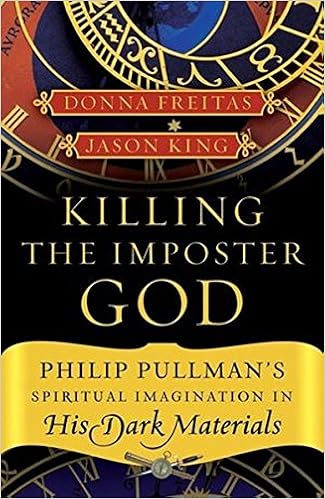
Image result for killing the imposter god

Killing the Imposter God, by Donna Freitas and Jason King

A work similar in spirit to Tony Watkins' excellent Dark Matter, in that Freitas and King situate HDM within a thoughtful Christian context, Killing the Imposter God goes a little further towards building up a scholarly theological apparatus for reading the trilogy. While the background in liberation theology, process theology, and feminist slants thereof is the book's strongest contribution, perhaps its greatest weakness is actually in how little it engages with other critical readers of Pullman, scholarly and more traditionally theological alike. Making a reading of HDM, rather than the secondary literature, their priority, though, is obviously the right move if one of the two has to be sacrificed for the sake of concision, or to appeal to a broader audience.

Their revisionist stance is announced in the authors' contention that Nietzsche's Zarathustra doesn't necessarily speak for the philosopher, emphasizing less the death of God than the birth of a new conception of God. Warranted or not, they place Nietzsche at the head of a lineage that stretches through Whitehead, Gutierrez, Boff, Keller and McFague. In short:
Pullman wrote this trilogy during a theological era when alternative visions of the divine abound, so it is hard to understand how Pullman overlooked all these available alternatives and why he seems unable--or at least unwilling--to consider his own alternative divinity [ie, Dust] in the trilogy. Pullman has by no means killed off God in general. He has killed off only one understanding of God--God-as-tyrant--and an oddly antiquated and unimaginative one at that. (19, cf. Pullman's critique of 'epicycles' in his interview with Watkins)
Again, the argument looks at Pullman's story, rather than his public pronouncements:
Once we are able to set aside Pullman's personal professions of atheism, it is not difficult to see how Dust takes on many qualities that are typically associated with the divine. Dust existed since the beginning. It always tells the truth... Dust is the source of all creation... And in The Amber Spyglass, we learn that Dust has yet another name: Wisdom--a name for God that many feminists have devoted much energy to exploring. (27)
Dust holds everything together. It takes on different forms to become spirit, soul, and body, and to make a person. In this way, Dust becomes matter and the world. Even the angels and the Authority are created and formed out of Dust... (51)
Now, surely that would imply that Dust does tell lies, starting with Authority claiming to be the Creator, all the way down to Lyra, until she learns the value of telling true stories? It may become a matter of semantics rather than metaphysics, but I wonder if the lengths to which Freitas and King take Dust might have been better informed by a brush with Rogers' vitalist monism. A similar squishiness enters in once they start talking about "agapic love" (93). All sorts of love are represented in Pullman, to be sure, but this one popularized by Lewis is probably further from his mind than Blakean (or even Dantesque) desire, which get much shorter shrift. One interesting distinction does get pushed quite firmly, though:
This claim [by the review in First Things]--that Pullman's notion of salvation is too shallow--is itself shallow. The end of The Amber Spyglass cannot be reduced to two distinct salvific moments--one superficial and one more complex. It should be understood instead as a complicated drama of salvation in three intimately interconnected acts, all of which are linked and indispensable, and correspond to his triune vision of humanity and panentheistic understanding of the divine. (108)
Those three moments, if I have them straight, are the descent into the underworld, the romantic awakening, and the final return to their own worlds. This is the strongest stretch of the argument in the book, for me. The tail end of the series has always been the most complex and difficult for me to interpret, and while I don't go along with them all the way, Freitas and King do a great job offering some support for the position that HDM's ending, far from being a disappointment as many readers feel, is worthy of the story as a whole:
In what may be the most powerful section of HDM (when Lyra decides to free the ghosts...) Lyra ... becomes the new Moses... Dorothee Soelle argues that humanity learns its purpose in creation through the Exodus story. "In the beginning," she writes, "was liberation." (120, cf. Soelle, To Work and to Love: A Theology of Creation)
Many liberation theologians read Exodus as logically preceding Genesis; the Israelites have to be liberated from slavery to become a people, and only once they are a people do they ask about and remember their creation. Similarly, it is possible to read God's revelation ...  to his chosen people as an act, not only of saving the Israelites but also of saving God... [Pullman's] story culminates, not in the death of God but in God's [ie, Dust's] salvation. (152)
Pullman has come to a surprisingly Christian conclusion. Echoing the Gospel of John, he seems to conclude that the key to the universe is love and that Real Love requires great personal sacrifice for the love of others. Jesus' mission was to save people... (156)
If the preservation of consciousness and creativity and everything else that Dust represents requires sacrifice--even the sacrifice of erotic love, at least on a personal level--then we must be prepared to make that sacrifice, to say the goodbyes that it demands (157)
The story of Lyra and Will becomes a new Gospel, "the grand story of salvation," complete with a creed (166).
It is also surprisingly Greek, indebted nearly as much to Socrates and Plato as to God the Father and God the Son. In these novels, preserving true knowledge seems to be more important than preserving true love. In the end, the mind trumps the body. Consciousness trumps matter. Divinity demands the sacrifice of humanity. (158)
Will and Lyra are asked by the force of circumstance to give up the expression of embodied love of each other, in exchange for the realization of a more ultimate love--their Love of Dust. Whether this is good news is up to the reader to decide. But there seems to be something of a Fall, even in Pullman's Gospel. (159)
Very much so! And it's an aspect of the story we'll see in a new light, perhaps, with the release of the further Book of Dust. Too much gets conflated and set into rhetorical flourishes there for me. The interview with the author of Wicked also seems like an odd fit, though he has some interesting points. Still, Freitas and King represent an important contribution to the study of Pullman's initial HDM trilogy.


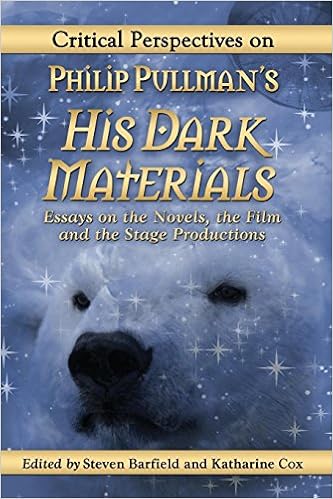
Image result for critical perspectives on pullman's trilogy cox

Critical Perspectives on Philip Pullman's His Dark Materials: Essays on the Novels, the Film and the Stage Productions, edited by Steven Barfield and Katharine Cox

As Freitas and King were preceded by Watkins in their religious study oriented towards a popular audience, so Barfield and Cox follow Lenz and Scott down the academic essay collection path. Regrettably, they do not measure up in their scholarship; however, just as in the Lenz and Scott book, there are a few essays here which stand out and are well worth an ILL read.

Introduction, Katherine Cox
In the first place (aside from a plug for her entry on Pullman in the Literary Encyclopedia), Cox mentions Pullman's biographical sketch, but gives little indication of how marvelous it is. Remarking on his interest in education, she does not refer us directly to his essays or their contexts. Nor do I recall any reference to the prior Lenz/Scott essay collection. Nevertheless, the theme of education, specifically Pullman's own, but also the field of Pullman studies, such as it is, seems like it would be a helpful framing principle for a book like this. Instead, it is dropped in favor of brief summaries of each of the pieces within their (tired, arbitrary) thematic groupings. There are pleas for the novelty of perspectives we'll be offered on music, science fiction, Victoriana, gender, adaptation--which is all there, whether it touches the heart of Pullman's work or not--and so are the usual suspects, already adequately trotted out: influences of Lewis and Tolkien, to say nothing of Milton and Blake, and rehashes of theological arguments. The whole thing feels rather dry and desultory, and we haven't even got into the essays themselves...

I. Adversaries and Influences

"Recasting John Milton's Paradise Lost: Intertextuality, Stroeytelling and Music," Rachel Falconer
Aside from pointing us towards a couple of handy reads--one primary, "What! No Soap?" by Pullman (though it turns out this is the same as "Children's Literature Without Borders" in Daemon Voices); the other secondary, Revolution in Poetic Language, by Kristeva--and delivering a few interesting thoughts about Pullman's appreciation of music, with reference to the figure of Orpheus as transmitted by Milton, Falconer provides a decent overview of the story's indebtedness to the epic poet but few substantially new insights. Focusing in on the world of the dead and developing the Orpheus thing further, with greater attention to the Maenad-like witches, say, who actually sing the only song in the whole series, aside from the epigraphs or Mrs Coulter's wordless lullabies, would have been helpful. For a stronger take on Milton, I recommend again Shohet's essay in the Lenz/Scott volume.

"'When I Grow Up I Want to Be...'": Conceptualization of the Hero Within the Works of C.S. Lewis, J.R.R. Tolkien and Philip Pullman," Phil Cardew
Skip this sweeping, facile look at heroism in favor of reading practically any of the numerous entries cited in what is really a ludicrous list of works for such a slight essay: the likes of Frye, Genette, Propp, to say nothing of Tolkien and Lewis' essays, which even Pullman acknowledges the value of, much as he detests their fiction. On the topic of the bear's son motif, briefly brought up by Cardew, a really good essay might be written comparing Will and Iorek; or on the beauty and the beast motif, to bring Lyra into it a bit more... But the insistence on reading Pullman with reference to Lewis/Tolkien is unhelpful and forced and frankly impossible to address in a meaningful way in such a short space.

"Constructions of the Child, Authority and Authorship: The Reception of C.S. Lewis and Philip Pullman," Elisabeth Eldridge
Through an intricate use of scare-quoted names, Eldridge shows ample evidence to prove a couple of simple points: that there is an important distance between the author and the narrator, provoking problematic misunderstandings by those who try to read them as if they were the same, and that there is a tension between the reading of these works by adults and children, creative in itself but again problematic when the adults try to make dogmatic assertions on the children's behalf. In a somewhat belabored critique of critiques pro and contra Lewis and Pullman, Eldridge comes to the unsurprising conclusion that these critiques end up mirroring one another, opposed as they are. Fine academic writing, but it really doesn't give us any insight into the story. Gray's work, building on Bloom's theory of anxiety of influence, is considerably more illuminating.

"'Dark Materials to Create More Worlds': Considering His Dark Materials as Science Fiction," Steven Barfield
In this piece, by one of the co-editors, no less, the sloppy editing of the collection really begins to become apparent, both in terms of run-on sentences and typographical howlers, and in the overall arbitrary order of the pieces and division into sections. It's too bad, because there is some interesting material here in the mess. Barfield cites Pullman's Foreword to Doctor Who: The Writer's Tale, and mentions his stage adaptation of Frankenstein--either of which would have been excellent topics to focus an essay around, rather than scattered bits and pieces of science fiction theory: alternate history, Amis' The Alteration, Suvin's novumClarke and Asimov's laws, Lewis' Space trilogy, L'Engle's Time Quintet.. .The Kendal Mint Cake parody of Raphael in Milton, from whose epigraph the essay starts, actually supports a read of the trilogy as satire as much as sci-fi. Finally, one more curiosity worth looking up: Uselton's paper on structural myth, hardly less amateurish than the sort of things I write.

II. Traditions and Legacies

"Revitalizing the Old Machines of a Neo-Victorian London: Reading the Cultural Transformations of Steampunk and Victoriana," Steven Barfield and Martyn Colebrook
Again, a lovely mess. Of the two (quite distinct!) topics the essay purports to cover, the authors' look at steampunk technology includes a read of the bomb chapter that's pretty interesting and original, if a little sloppy. We hear about Gibson's The Difference Engine, but not much about the Cave, the computer of Mary Malone. The alethiometer, the subtle knife, the intention craft even, are touched on only very briefly--could it be that they don't actually fit that well into the steampunk genre? On the other topic of Victoriana, we hear a bit about the dystopian London setting and Pullman's Sally Lockhart mysteries and early short stories, suggesting avenues for further study without actually providing much in the way of analysis.

"Revisiting the Colonial: Victorian Orphans and Postcolonial Perspectives," Laura Peters
The first really insightful piece in the collection. Pullman has acknowledged his status as a colonial child, and this is one of the ways in which his life story actually does parallel Tolkien's, besides his semi-orphanhood. Peters notes the echo of boy's own narratives in the descriptions of John Parry, sees the aspiration towards post-colonialism in the figure of King Ogunwe, and the Romantic leanings tempered by Pullman's vaunted realism, but her conclusion suddenly brings in way more material undigested. This by way of sensing, rightly, the crucial importance of that storytelling theme, but that would take another essay, or a book, to adequately treat! To discuss Blake's 'for empire is no more' epigraph alone would have been a much more satisfying way to close the piece.

"Exploring and Challenging the Lapsarian World of Young Adult Literature: Femininity, Shame, the Gyptians, and Social Class," Nicola Allen
Another essay, like Barfield's, riddled with grammatical errors. Sentences that ran on have simply been studded with periods, leaving fragments of what might actually have been interesting thoughts to languish in lapsarian shame. Why not just say fallen? Or better yet, actually explain what that is supposed to mean, in the context of a book which is entirely predicated on reinterpreting the story of the fall? Instead, we get Kruks reading Foucault through Beauvoir. It's hard to take Allen's points about the gyptians and other supposedly representative female characters seriously when the witches are straw-manned and Mrs Coulter's development all but neglected. The seed of a worthwhile essay is there in the use of the word grace for Mrs Coulter's charms and her theological interests, but that is not this essay. Quotes from a Lambert interview take the place of a structuring principle; references to Rowling and Gatty's Tale are beside the point for anyone mainly interested in HDM.

"'Imagine Dust with a Capital Letter': Interpreting the Social and Cultural Contexts for Philip Pullman's Transformation of Dust," Katharine Cox
Maybe the only finished essay in the book. Cox addresses Dust head on, putting her finger on the sort of semantic interplay of levels that reference to grace in the previous essay did, and actually developing an argument from it. For me, there is still too little Dust (which would mean looking at more passages from the text), too much dust (deep dives into the social contexts of domesticity and sanitation, glances at physics and ecology). But that's what the title promised, after all, and as academic papers go, it's perfectly well-written. Cox even references a few other scholars in Bird and Shohet, but does not engage with Freitas and King's sweeping arguments about Dust at all. Nor does she seem any more aware than I was (before Dr Shohet indicated it for me) of Rogers' masterful monograph on Milton and the vitalist moment.


III. Religion, Sexuality and Gender

"The Man Who Walked with God: Philip Pullman's Metatron, the Biblical Enoch, and the Apocrypha," John Haydn Baker
This one is pretty well done, too. Baker tackles Enoch just as squarely as Cox does Dust, and strikes a good balance between drawing on different sources and speculating on how Pullman actually seems to use them in his story. There are even some larger issues hinted at, about the Bible and apocrypha, which I'd have loved to see compared in some way to Pullman's treatment of Christ and the Church, whether in HDM or in The Good Man Jesus and the Scoundrel Christ. Say, with more attention to those differences in Asriel's Bible, or in terms of Mary Malone and the Pauline triune nature of body, soul, and spirit? We also get a couple of wild Blake drawings helpfully pointed out for us, which always makes for fun discoveries. 

"The Republic of Heaven: East, West and Eclecticism in Pullman's Religious Vision," J'Annine Jobling
For whatever reason, Jobling insists on making Pullman's cosmos fall into line with Buddhism, even whilst acknowledging the vagueness of any attempt to generalize about Buddhism, particularly as it's understood in the West. It's all rather mushy. Again, engaging more with Freitas (who is cited) and Rogers (who isn't) might have provided a little shape to the argument, whereas references to Gresh only compound the sense that what is at stake is only a matter of nomenclature. The verbal echo between Pullman's sraf and karmic asrav is fascinating, but only makes a footnote. A nod towards environmentalism, of course undeveloped, closes the piece. Somehow this essay focused on the East includes nary a mention of the I Ching nor the whole Himalayan interlude of TAS.

"'Walking into Mortal Sin': Lyra, the Fall, and Sexuality," Tommy Halsdorf
Like many of the pieces, this could have fit either into the legacy or the adaptation sections as well or better than it does in the religion and gender one. In a variation on the question (answered by Milton resoundingly in the affirmative) Did Adam and Eve have sex in Eden before the fall? Halsdorf asks if Will and Lyra had sex at the end of TAS, and answers, rightly, that we don't know. Pullman's ambiguity on the point is well attested and would be worth considering at greater length in the light of his statements about authorial intention. Instead, we get some references to Milton and Blake and the bible, but also to Lacan's jouissance and the work of Wright and Butler on the HDM plays, which are worth following up. The quotation from the title about "walking into mortal sin," a very interesting one for this question of authorial intent and narrative voice, is never addressed. It also would have made sense to read Pullman's early Gnosticism- and sex-laden novels, but they're so difficult to find copies of that scholarship on them might never happen.

"Becoming Human: Desire and the Gendered Subject," Sarah Gamble
Another Butler is the subject of this essay, which sets Judith Butler's gender theory against a vaguely posited normative standpoint, and places Pullman's story into the resonating chamber between them to see how it fares. Mrs Coulter and Lord Asriel, Will and Lyra and their daemons, all get somewhat more careful attention than in most essays, but once again, Mary Malone is conspicuous by her absence. Moruzi is cited, along with "Womanliness as a Masquerade," to go along with this Butlerian spine, the upshot of which is to establish Pullman's radical politics and declare HDM safe to read for those concerned about woke bona fides. What a relief.

"After the Fall: Queer Heterotopias," Sally R. Munt
Revised from a book chapter, and it shows at times as the word shame is deployed in a particularly loaded fashion, as if we know what is meant by it. But perhaps we learn through the context of the essay itself, which is really very strong. Munt lays out a theory of self as narration derived from Cavavero and Irigaray, less sociological perhaps than Butler's stance, and places Pullman into conversation with the likes of these authors and Foucault in a remarkably lucid fashion for a change. She demonstrates a knowledge of a range of earlier works on Pullman, including a series of articles by the Rustins, and meaningfully builds on them with a quite novel interpretation of Lee and Hester, Baruch and Balthamos, and the colorful concepts of romantic heterocosms and heterotopias. Probably the essay which I learned the most from, and one that might actually put Pullman's achievement in a new light.

IV. Dramatizing HDM

"Staging the Impossible: Severance and Separation in the National Theatre's Adaptation," Patrick Duggan


"Staging and Performing HDM: From the National Theatre Productions to Subsequent Productions," Karian Schuitema

These are two more of the most interesting pieces in the collection, along with Cox', Baker's, and Munt's essays. Not, perhaps, as insightful into the books themselves as those were, what they do is to give a glimpse into the stage adaptations, which are otherwise inaccessible to us. Along with his illuminating notes on the dramatic experience, Duggan brings to bear trauma theory of dubious persuasiveness, but Schuitema offers a densely researched look at subsequent productions beyond the National Theatre run and includes an interview with the director of Playbox Theatre, to help make the reporting more concrete. Questions of the difference between adults and children, so central to Pullman's story and his great idea of the daemon, are cast in a fascinating new light. 

Overall, the collection is a little disappointing, but it highlights a number of other scholars I haven't had time to touch upon, and opens considerable vistas on room for improvement. 


Image result for continuum contemporary squire pullman

Continuum Contemporaries: Philip Pullman's HDM Trilogy: A Reader's Guide, Claire Squires

This is probably the closest thing to what I would want to write, only I would want to write a much expanded, ever-updating version. In many respects, Squires work is consummate competence: her summary of Pullman's biography is excellent, and she does a smooth job of synthesizing a great deal of story and thematic material in a very brief space. There are a few outright errors: her assertion about what Asriel says to Lyra about Dust at the end of the first book and Pan's summary of it later leaves out what Asriel says to Mrs Coulter at the end of that book and then retcons later in his conversation with her in TAS; Squires calls Tony Makarios an old friend of Lyra's, which might be a mix-up with subsequent adaptations where the character is merged with Billy Costa, whose brother is also, confusingly, named Tony. She also puts a great deal of weight on the catch-all term politics, whereas I tend to think of that as largely a red herring in Pullman's story, subsumed under the much more important process of storytelling. Still, she is a perceptive reader overall, asking brilliant questions, connecting widely separated quotes from within the books, as well as essays, speeches, etc, and reviews (up until about 2003). A handy little volume, nothing earth-shattering, but I'll have to check out her other book on Pullman, Master Storyteller.