Sunday, March 24, 2019

Reviewing the Literature: Books about Pullman

From the top:

The best writing about Philip Pullman and his work (by someone other than him) that I've found so far is Lauren Shohet's "Reading Dark Materials." A relatively short essay, it articulates an endlessly fruitful interpretive approach to the original series, and to Milton's Paradise Lost, for that matter. (See a fuller review here.)

To my knowledge, the best book-length treatment out there is Laurie Frost's His Dark Materials: The Definitive Guide. This encyclopedic survey carries an appreciative foreword from Pullman: "I can't recommend it too highly to the reader who's found anything interesting or enjoyable in this story of mine. I know I've returned to it frequently during the writing of the book I'm doing now, and I know I'll continue to do so." An inexhaustible trove for writer and readers alike, then.

A balanced, insightful critique of Pullman's theology, blended with admiration for his story, comes from Tony Watkins in Dark Matter: Shedding Light on Philip Pullman's Trilogy HDM. Incorporating his own remarkable interview with the author, as well as generous references drawn from the mass of source material already out there by 2004, Watkins does a tremendous job laying the groundwork for several major lines of inquiry. If he had spent less time on summary and biography, useful in themselves but probably not requisite for readers of the series looking for the analysis he stands poised to provide, he would have been able to give greater space to exploring themes like daemons and Dust and the handling of science in much more depth. As evidence of his acumen, I include a few examples:

"Now 'Lyra had to adjust to her new sense of her own story, and that couldn't be done in a day' (p. 130). There are echoes of Pullman's own story here. He started writing The Golden Compass in the early 1990s, sometime around, or soon after, the death of his mother. It was while he was subsequently sorting through her papers that Philip unearthed things about his parents that he had never known. His discoveries were not on the scale of what Lyra is told, but something of the same reorientation of perspectives must have taken place." (67 cf. Pullman's biographical sketch I have a feeling this all belongs to me; also Iorek's words to Will, cited Watkins p 88: "'If you want to succeed in this task, you must no longer think about your mother. You must put her aside. If your mind is divided, the knife will break' (p. 194)." ) 

"There's a book [mentioned in Lyra's Oxford] on 'some curious anomalies in the mathematics' of the Four Books of Architecture by one of the world's greatest architects, Andrea Palladio (originator of the Palladian style). The book is by one Nicholas Outram--these are Philip's middle names." (101)

"Incidentally, Lord Asriel's comments about this verse [ie, Gen 3:19]--that the translation is disputed because the text is corrupt, and that it could mean God is admitting his own sinfulness (GC, p. 373)--are unjustified. I have yet to find any commentator arguing for an alternative translation of 'to dust you will return.' [his endnote: Some commentators do disagree with the majority in that they take 'to dust you will return' as something that was always inevitable for Adam, even before his rebellion. In other words, he would have died whether he sinned or not, and the judgment on him is that work will now be difficult for him until that time. Most see physical death as being part of God's judgment and a consequence of being expelled from Eden. But this difference of opinion is over what the words imply, not over the translation itself. See Gordon Wenham, Word Biblical Commentary...] And the idea that this could have any reference at all to God's nature has no basis whatsoever outside Pullman's fictional world." (123) 

"When I asked Pullman to explain what he meant by 'interrogating the universe,' [from an interview with Charles Brown, at this defunct link], he replied [by email]: 'Perhaps "interrogating" is too fierce a word (not least in view of the pictures we've seen from Iraq recently [presumably from US soldiers humiliating and/or waterboarding prisoners]). I should have said something like "respectfully questioning." Human beings have got lots of ways of doing this; as well as the ones I mentioned, there is astrology, palm-reading, etc. I don't think these things give true answers; but what they might do--especially the more intellectually complex or enigmatic ones--is help you focus your question more precisely. So the answer you seem to be getting from them is actually coming from you. Probably.'" (136)

Thursday, March 21, 2019

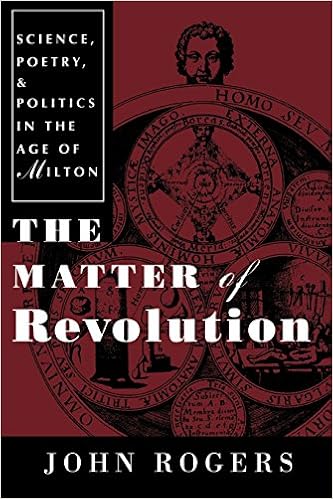
The Matter of Revolution, by John Rogers


Recommended by Lauren Shohet during our talk on Pullman, John Rogers' The Matter of Revolution: Science, Poetry, and Politics in the Age of Milton is indeed a magnificent work of scholarship. I thought the name sounded familiar, and with good reason: along with Mazzotta's Dante lectures, which are tough to match, I've also enjoyed listening to Rogers' Yale Open Course on Milton

Image result for john rogers matter of revolution


This book is much more technical, but it still remains mostly accessible and of interest to the general reader. Rogers posits a Vitalist Moment, an alternative to the dilemmas posed by the intellectual currents of predestination (Calvin) and mechanistic determinism (Hobbes) prevalent in the mid 17C, and he goes on "to tie a radical science to a radical politics and theology" (8). It's only a moment, because the monism of intelligent matter proved to cause too much tension to be sustained, even among its enthusiastic adherents; or else the world could look very different today. As it is, vitalism contributed to a revolution which is preserved in surprising ways in the literature of the time, and thus still has the potential of resurgence, should we care to read it. In the course of the argument, Rogers draws on authors clustered around the English Civil War, well-known poets like Marvell and Milton, but also Harvey, the anatomist, Winstanley, the radical, and Cavendish, a noblewoman and philosopher. Of them all, the latter's proto-fantasy/sci-fi The Blazing World sounds the most intriguing and potentially fruitful for the student of Pullman's HDM.


Along with burgeoning science and refined poetry, we hear about the Puritans and Royalists whose disputes carried over into the New World, as well as the Levellers and Diggers, whose utopianism did, too, in a way. We trace back to their encounters with vitalism the roots of liberalism in economics, and of the individual in politics. 

Along with Rogers' excellent read of Paradise Lost in this rich context, we get an elegant appraisal of Marvell, bracketed by introductions to the lesser-known Winstanley and Cavendish. The one a dreamer-populist, the other the first female member of the Royal Society, both were also authors of problematic programs of reform, which nevertheless shed light on the inherent tensions of self-rule.

A fair bit of the argument is too subtle for me--connections between Harvey's anatomical anecdotes and King Charles' beheading, for instance, are startling and thrilling, but seem like a stretch--but the link Rogers discerns between physics and politics is fascinating. Experimental theologians curious about Dust will have much food for thought in Rogers' discussion of chaos, generation, and alchemical tartar; or in his analysis of vitalist monism generally: "With the capacity to govern themselves, these infinitely wise particles are the architects of a true commonwealth" (198-99). A critical voice, in many respects a precursor, for Pullman's call for a Republic of Heaven to contend with. 

Guest Post on Daemon Voices for A Pilgrim in Narnia

Many thanks to Brenton Dickieson for inviting me to write a piece for him and his readers! It should come as no surprise that it's about Philip Pullman, who else?


Sunday, February 24, 2019

Genteel Paradoxes: Poetic Diction and Saving the Appearances, by Owen Barfield

C.S. Lewis called Owen Barfield the "wisest and best of my unofficial teachers," and Barfield's Poetic Diction: A Study in Meaning is dedicated to Lewis (or, in the original publication of 1928, to Lewis' then-pseudonym, Clive Hamilton). The accompanying inscription, 'opposition is true friendship,' Barfield quotes from Blake's Marriage of Heaven and Hell, a work Lewis would later counter with his Great Divorce. Further epigraphs hail from Aristotle's De Anima and Coleridge's Biographia Literaria. As the one is left in Greek, and the other comes from somewhere in the middle of a long philosophical memoir, we might have an idea of what we're in for reading Poetic Diction. Barfield writes for an audience of people, like his friend-opponent Lewis, who are versed in language and literature, history and philosophy, and for whom controversies of logic and metaphysics rooted in the theories of the Greeks and Romantics but also in Locke, Hume, and Kant are live and urgent. Presumably, whatever might have motivated his early readers, most of us who come to read Barfield today do so by way of Lewis and Tolkien, rather than by passing through the rich intellectual tradition in which the Inklings themselves were steeped. Thus, my main impression reading Barfield's work is of a sort of super-grown-up talking over my head--and this is not meant so much as a criticism of it as a recognition of my own insufficiency. Though I can count myself lucky for having avoided some of the prejudices and pomposity of Barfield, Lewis, et al., which I fancy I can detect here and there, I'm sure I am full of my own updated ones, as well as being just generally much more ignorant and uneducated.

It seems like there are two ways to approach Barfield, then. Either we read him mainly for the light he can shed on Tolkien and Lewis--and this seems to be the trail blazed by Flieger in Splintered Light--or we strive, by reading many more and still wiser authors he draws upon and puts himself in conversation with, to understand his contributions to the much larger currents of thought he saw himself and his circle engaged in. For the former, a summary of his thought probably suffices, and all these allusions and foreign languages can be dispensed with. But the latter is clearly preferable, if we can work up the time and effort to undertake it; indeed, the former probably ought to lead into the latter, as Flieger seems to argue: "Barfield is not a fantasist (though he is the author of a deftly humorous retelling of 'The Frog Prince,' The Silver Trumpet. Primarily, however, Barfield is a speculative thinker and philosopher whose interest lies chiefly in the relationship between language, myth, and cultural reality" (xxi).

Making it our goal to find the way back to myth and truth through fantasy makes sense, too, given Barfield's association with and influence on these luminary authors, better known for their fantasies but also possessed in their turn of a wealth of scholarship and religious insight speaking powerfully to our time if we can manage to hear, to learn the language in which to understand them. Another don of Tolkien scholarship, Tom Shippey, makes the argument at some length in works like Tolkien: Author of the Century, that the writer of The Hobbit  and The Lord of the Rings, but also of The Silmarillion and On Fairy-stories, eminently deserves serious study alongside (or indeed slightly above) the giants of modern and post-modern literature. The likes of Woolf, Eliot, and Joyce, after all, for all their brilliance, seem to have sadly hollowed out the rolls of English departments, whereas the popularity of Tolkien and Lewis has been the impetus not just for major films leading new generations to their fantasy books, but also for scholarship delving into to the full range of their work and into the sources they draw upon.

Barfield, then, is an essential guide in this adventurous "Study in Meaning," of which there seems to be a revival perennially in the works. Whether in the focused Poetic Diction or in the sweeping Saving the Appearances, his erudite explications of exemplary passages of text, his logical refutations of counter-arguments we'd likely not dreamt of making in the first place, and his impassioned calls for ever more nuanced and subtle attention to the workings of imagination and consciousness are quite the experience. Numerous shorter works freely accessible on the page of his literary estate, which calls him, a little apocalyptically, "the first and last Inkling," will give you a taste of his style (oratorical, elliptical, sententious) and a sense of his driving concerns (philology, cultural history, mystical participation).

(Hereabouts is where I would give a more detailed analysis of a few of Barfield's books, and maybe someday I will, buckling down to study Greek and Coleridge and all that before re-reading them, but I just don't think I understand them well enough to be much help at this point. Still, I would love to hear from anyone out there who does!)

Intriguingly, while Barfield had such a tremendous impact on Lewis and Tolkien, and thus on anyone who's been led by them to try to read Beowulf in Old English or to see in Chaucer or in a church window a tenth of what a medieval might have seen there, he also cites some surprisingly esoteric "'friends'" in his afterword to Poetic Diction. Chief among Barfield's enthusiasms are the founder of Anthroposophy, Rudolf Steiner; Goethe, the unacknowledged scientist; and numerous thinkers he recognizes as partaking, along with Barfield himself, of "Neo-Platonism, an underground stream, and philosophically no longer quite respectable" (223). The inexhaustible reading list Barfield bequeaths  also includes Spengler's Decline of the West (featured prominently in Conroy's Lords of Discipline, it took me a while to realize this was a real book); Jung, Freud and other students of "the so-called 'psychology of the unconscious'"; Giambattista Vico; Susanne Langer; and many others one would hope to see courses about on Mythgard or Signum University someday. But we should hasten to browse among them in the meantime, to talk about them with other intrepid readers, and so to continue to pass along the thrill of discovery caught from the venerable Barfield.

Monday, February 18, 2019

Beyond Ideology, by Frances Lee

Frances Lee gave an interview with Ezra Klein recently on his podcast which explored some of the points she raises in her book, Beyond Ideology, on the strength of whose fascinating title alone I would have read it. The conversation is also excellent and well worth a listen. In essence, though the two parties have become more ideological, Lee argues that the very structure of parties and of the American political system have driven confrontations between Democrats and Republicans just as strongly. This understudied component of political conflict, which may be summed up as teamsmanship, or, with a nod to The Federalist, as factionalism, gets careful analysis, particularly focusing on the US Senate.

As I'm no political scientist, I skipped the graphs and tables and some of the discussions of statistics, but they all seem impressive. They clearly support the thesis, from what I can tell, and would tend to support the importance of Klein's style of journalism, too, which delves beneath labels and personalities, helping to make sense of the news with more encompassing explanatory models, which are themselves constantly being interrogated anew.

A History of God and The Battle for God, by Karen Armstrong

I read the earlier History of God first, since it covers the broadest swath of history, and then The Battle for God, which focuses on the past 500 years or so. The latter is strongly recommended by Pullman in his essay Miss Goddard's Grave. He writes:

Karen Armstrong, in her book The Battle for God, explains the nature of fundamentalism very well. She sets out the difference between 'mythos' and 'logos', differing ways of apprehending the reality of the world. Mythos deals with meaning, with the timeless and constant, with the intuitive, with what can only be fully expressed in art or music or ritual. Logos, by contrast, is the rational, the scientific, the practical; that which is susceptible to logical explanation.
Her argument is that in modern times, because of the astonishing progress of science and technology, people in the Western world 'began to think that logos was the only means to truth, and began to discount mythos as false and superstitious'. This resulted in the phenomenon of fundamentalism, which, despite its own claims to be a return to the old true ways of understanding the holy book, is not a return of any kind but something entirely new: 'Protestant fundamentalists read the Bible in a literal, rational way, that is quite different from the more mystical, allegorical approach of pre-modern spirituality.' (Daemon Voices 409)

Armstrong's later book MYTHS has an introductory essay by Pullman. It may well be that his character Mary Malone, like Armstrong an ex-nun turned scholar, owes something to the prominent author, as well. Armstrong, in turn, draws heavily on this concept of mythos and logos as set forth by Sloek in Devotional Language, along with important works by the likes of Eliade, Scholem, Tillich, Marsden, Steiner, and many others I don't recognize.

Armstrong has garnered many admirers. Her organization Charter for Compassion, launched in collaboration with TED and with chapters around the globe, aspires to convert her scholarship into action, but may well founder on that same underlying difficulty of balancing mythos and logos in individuals and the world which so drives her argument. Both History and Battle are tremendous, and I'm scarcely able to do them justice in this brief note on Pullman's sources. My only critique is that they give very little room to any number of incredibly important parts of the story of religion; long as they are, of course they can't hope to include everything. But to cite just a few examples which I consider absolutely critical to any history which pretends to grapple with religion, black churches in the US and Kierkegaard receive terribly scanty mention, and CS Lewis and his forebear MacDonald are dismissed as "more marginal writers" -- albeit in comparison to Milton (BG 309). Still, Armstrong gives a brilliant overview of Western history through the lens of monotheism and fundamentalism, arguably two of its most significant contributions.

The Art of Memory, by Frances Yates

I was pretty sure I saw a reference to Frances Yates in one of CS Lewis' monographs, but I haven't turned it up now that I tried to find it again, dearly as I would like to. My main reason for reading The Art of Memory, though, is that Pullman is quoted in Frost referring approvingly to Yates, and he puts it at the end of this list of reading recommendations. I'm pretty sure Yates is an influence on Crowley's Little, Big as well. Whether these are reasons you might like to read it or not, they certainly shaped my approach to the book.

There are two main parts: everything up to Bruno, and everything after. In the former part, there's more historical context and more digestible information; in the latter, there's more of a sense of Yates' fascination with the material, which is complex and interesting, but which, perhaps by its esoteric nature, remains somewhat tentative and opaque. Yates' earlier book on Bruno is the next one I'll try to get a copy of. Even without more background on the Renaissance man of mystery, though, than some familiarity with his statue in the Campo dei Fiori, or perhaps the moving poem by Milosz, you get tantalizing hints in the second half of The Art of Memory of a whole obscure history of magic and idealism breathing from nearly forgotten books with titles like Shadows, Circe, and Seals, abbreviated translations of much longer titles in Latin.

Image result for bruno statue in rome

Yates does an admirable job weaving this unruly and wondrous Renaissance material into a larger and if possible still more audacious project of tracing memory, its theory and practice, from the classical sources to its impact on Shakespeare's Globe Theater. "The vivid story of how Simonides invented the art of memory is told by Cicero in his De oratore"; besides this primary source, which opens the book with a bang, we see related passages in Quintilian about the use of the zodiac as a mnemonic structure. These fragmentary classical origins are developed through medieval transmission by Thomas Aquinas, who draws on Aristotle and the Bible to range memory under the virtue of Prudence, and Dante, whose circles and spheres fit the ancient rhetorical-pictorial tradition, and they flower in the Renaissance in the ornate but lost "Memory Theatre" of Giulio Camillo, who aspired to a total integration of human and divine knowledge with the aid of symbolic images. Bruno's hermetic explorations follow. The microcosm of the memory artist, still more amazingly, maps onto the Shakespearean theater, with its proportions and starry canopy reimagined by Yates through her reading of Fludd, and in a compelling conclusion the powers of scientific inquiry are linked back to the imaginative memory tradition in the work of the polymath Leibniz.

For Pullman, the rich atmosphere of images surrounding the Renaissance, incorporating perhaps the wheels of Lull or the living statues of Hermetic Egypt, contribute much to the speech of Dr Lanselius, the witch consul, in The Golden Compass. For the Platonist in Lewis, no doubt much of the shifting planetary systems came into his Space trilogy. Crowley's debt is obvious, in his magus Ariel Hawksquill in L,B and even a Bruno character in his Aegypt books. But beyond these influences, Yates' own storytelling is incredibly powerful as daring history and as intellectual fun.